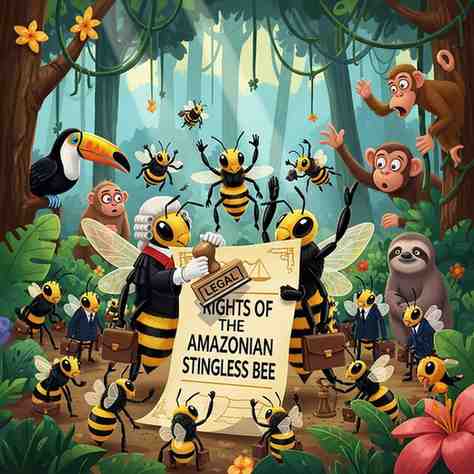
Historic Legal Recognition in Peru
In a landmark step for biodiversity protection, Amazonian stingless bees have become the first insects in the world to be granted legal rights . The recognition follows ordinances adopted by the municipalities of Satipo and Nauta in Peru . The move aims to safeguard these vital pollinators amid escalating threats from deforestation, climate change and forest fires across the Amazon rainforest .
Understanding Stingless Bees
Stingless bees belong to the Meliponini tribe and either lack stingers or possess non-functional ones. Native to tropical and subtropical regions, nearly half of the world’s approximately 500 species are found in the Amazon. Peru alone hosts over 170 species, making it one of the richest centres of stingless bee diversity globally.
Ecological Role and Food Security
Stingless bees have existed for nearly 80 million years and are among the most efficient pollinators in tropical ecosystems. In the Amazon, they pollinate more than 80% of plant species, including key crops such as cacao, coffee and avocado. Their decline threatens forest regeneration, biodiversity stability and long-term food security.
Cultural and Medicinal Value
Indigenous communities such as the Asháninka and Kukama-Kukamiria consider stingless bees sacred. Their honey is used in traditional medicine and has been scientifically shown to possess antibacterial, antiviral and anti-inflammatory properties. Unlike commercial honey, it has higher moisture content and a distinctive sweet-sour flavour.
Important Facts for Exams
-
Stingless bees belong to the Meliponini tribe
-
They pollinate over 80% of Amazonian plants
-
Peru hosts 170+ species of stingless bees
-
Municipal laws recognised insects’ legal rights
Month: Current Affairs - Jan 03, 2026
Category: Environment & Biodiversity