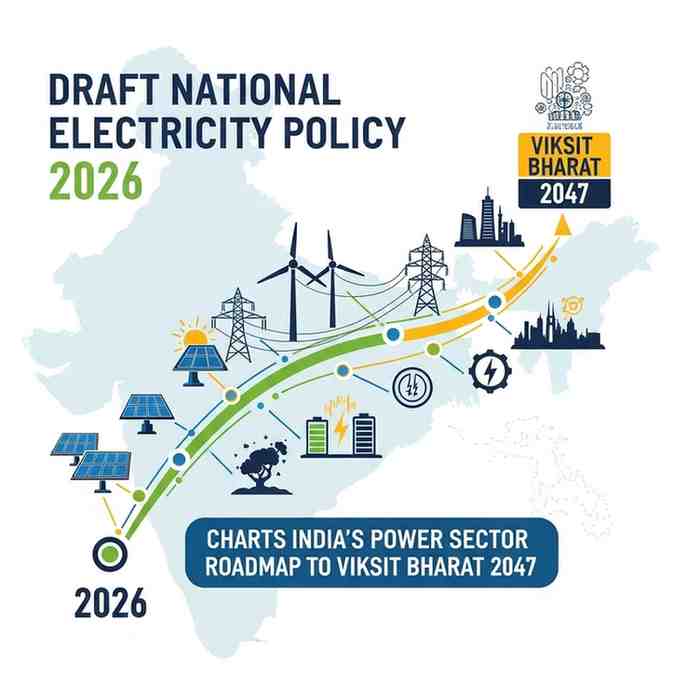
Draft National Electricity Policy 2026 Released for Consultation
The Ministry of Power has released the Draft National Electricity Policy (NEP) 2026 for public consultation, setting out a long-term roadmap to transform India’s power sector in line with the vision of Viksit Bharat @2047. Once finalised, the new policy will replace the National Electricity Policy notified in 2005, capturing the sweeping structural, technological, and market changes that have taken place over the last two decades.
How India’s Power Sector Has Changed Since 2005
Since the 2005 policy came into force, India’s electricity sector has expanded dramatically. Installed generation capacity has grown nearly four times, with private players emerging as major contributors. The country achieved universal household electrification by March 2021, operationalised a unified national grid in 2013, and raised per capita electricity consumption to around 1,460 kWh in 2024–25. Despite these gains, the draft policy acknowledges persistent weaknesses in distribution, including high accumulated losses, mounting DISCOM debt, non-cost-reflective tariffs, and continued cross-subsidisation.
Consumption Targets Linked to Climate Commitments
The Draft NEP 2026 sets ambitious consumption benchmarks to support economic growth and rising living standards. It proposes increasing per capita electricity consumption to about 2,000 kWh by 2030 and beyond 4,000 kWh by 2047. These goals are aligned with India’s climate pledges, including a 45% reduction in emissions intensity from 2005 levels by 2030 and achieving net-zero emissions by 2070. The policy seeks to strike a balance between energy security, affordability, and sustainability.
Structural Reforms Across Generation, Transmission and Distribution
A major focus of the draft policy is reforming the entire power value chain. It proposes advance resource adequacy planning by DISCOMs and State Load Despatch Centres, supported by a national-level plan prepared by the Central Electricity Authority. Financial reforms include automatic annual tariff revisions, greater reliance on demand-based charges, and a phased reduction of cross-subsidies—particularly for manufacturing, railways, and metro systems. The policy also promotes large-scale renewable energy deployment, battery energy storage systems, peer-to-peer power trading, and parity in scheduling and dispatch between renewable and conventional power by 2030.
Imporatnt Facts for Exams
-
National Electricity Policy is framed under the Electricity Act, 2003
-
Draft NEP 2026 replaces the National Electricity Policy notified in 2005
-
India has a net-zero emissions target for 2070
-
AT&C losses mean Aggregate Technical and Commercial losses
Generation Mix, Markets and Grid Modernisation
Looking ahead, the draft policy proposes expanding nuclear power capacity to about 100 GW by 2047, including the deployment of small and modular reactors. It also calls for faster development of storage-based hydropower projects and integration of energy storage with thermal plants. On the market side, reforms are suggested in power trading, transmission pricing, and distribution network operations. The draft also highlights grid cybersecurity, digitalisation, and indigenisation of critical technologies such as SCADA systems by 2030.
The Ministry has described Draft NEP 2026 as a future-ready, financially viable, and environmentally responsible blueprint for ensuring reliable and affordable electricity and has invited feedback from stakeholders before the policy is finalised.
Month: Current Affairs - Jan 23, 2026
Category: Power Sector Reforms | Climate Targets