ISRO Locks Landing Zone for India’s Most Advanced Lunar Mission
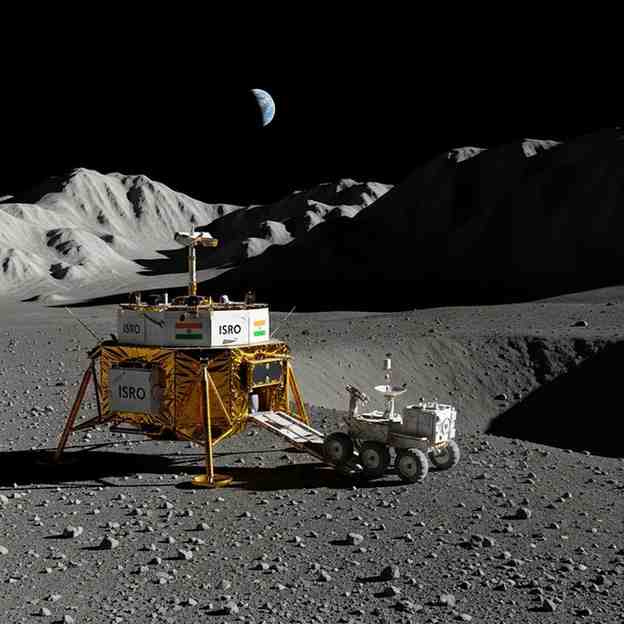
The Indian Space Research Organisation has confirmed a precise touchdown area on the Moon for Chandrayaan-4 , India’s planned lunar sample-return mission slated for launch around 2028. Identifying the site at an early stage is a key systems-engineering milestone, enabling trajectory design, hazard mapping, and validation of guidance algorithms for a complex multi-module operation.
South Polar Focus: Mons Mouton Selected
After evaluating multiple candidate zones near the Moon’s south pole, mission planners have chosen the Mons Mouton region—an area of high scientific value because of its rugged topography and proximity to permanently shadowed craters that may host volatile deposits. Among four shortlisted locations (MM-1, MM-3, MM-4, MM-5), MM-4 emerged as the preferred landing ellipse based on safety and navigational criteria.
Hazard Mapping and Terrain Suitability
High-resolution stereo imagery from the Orbiter High Resolution Camera was used to generate digital elevation models and surface hazard maps. The one-kilometre square assessment area around MM-4 showed the lowest obstacle density among the candidates. The site features an average surface slope of roughly five degrees and an elevation near 5.3 km, along with a higher concentration of hazard-free grids (approximately 24 m × 24 m). These parameters improve the probability of a controlled soft landing with precise touchdown dispersion.
Mission Configuration and Descent Strategy
Chandrayaan-4 is architected as a coordinated stack comprising a Propulsion Module , Transfer Module , Descender Module , Ascender Module , and a Re-entry Module . The combined Descender–Ascender assembly will execute the terminal descent to the selected site. After surface operations and sample acquisition, the Ascender will rendezvous in lunar orbit to transfer material for return to Earth, placing stringent requirements on navigation, guidance, and autonomous control.
Strategic and Scientific Payoff
Targeting the south polar environment positions the mission to investigate volatile chemistry, regolith properties, and geological history in a region of global scientific interest. Early site finalisation allows extended simulation campaigns and hardware validation ahead of the 2028 launch window, strengthening mission assurance for India’s first attempt to retrieve lunar material.
Exam-Focused Points
-
Chandrayaan-4 is planned as India’s first lunar sample-return mission .
-
The chosen landing location MM-4 lies within the Mons Mouton region near the Moon’s south pole.
-
Orbiter High Resolution Camera data supported slope analysis and hazard identification.
-
Mission architecture includes Propulsion, Transfer, Descender, Ascender, and Re-entry modules.
-
Early landing site selection enables optimisation of descent trajectories and risk mitigation.
Month: Current Affairs - February 10, 2026
Category: Science & Technology