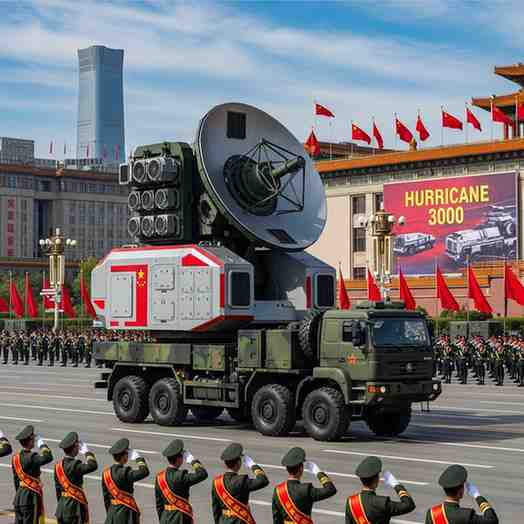
Hurricane 3000 Explained: China’s High-Power Microwave Counter-Drone System
China has revealed new technical details about the Hurricane 3000 , a truck-mounted high-power microwave (HPM) weapon developed to counter the growing threat of drone swarms on modern battlefields. Designed by defence major Norinco , the system is being positioned as a key component of China’s evolving counter-UAV and air-defence architecture, with a claimed effective range of over 3 km .
Rising Drone Threat and China’s Response
The rapid spread of low-cost, autonomous unmanned aerial vehicles has transformed contemporary warfare. Drone swarms, in particular, can saturate and overwhelm traditional missile- or gun-based air-defence systems. In response, China has invested heavily in directed-energy weapons , which offer a scalable and cost-effective alternative. The Hurricane 3000 represents Beijing’s most advanced publicly known microwave-based counter-drone platform.
Development and Public Showcases
The Hurricane 3000 first entered the public spotlight at the Zhuhai Airshow in 2024, where it was displayed alongside a smaller variant, the Hurricane 2000. It later appeared during China’s September 2025 military parade in Beijing , underscoring its perceived strategic value. Only recently have more detailed specifications been disclosed, confirming its primary role as a dedicated counter-drone swarm system rather than a conventional air-defence weapon.
How the Hurricane 3000 Works
The system uses radar to detect and track aerial targets, followed by electro-optical sensors for precise visual confirmation. Once engaged, it emits concentrated microwave energy through an antenna array, permanently damaging onboard electronics of drones. Unlike electronic jammers, which cause temporary disruption, HPM weapons deliver a “hard kill” by destroying critical circuitry almost instantaneously.
Range Claims and Global Context
Norinco claims the Hurricane 3000 can neutralise drone swarms beyond 3 km , enabling area-wide airspace denial. By comparison, the US-developed Leonidas reportedly has a range of about 2 km. While offering advantages such as low cost per engagement and minimal collateral damage, the Hurricane 3000 has not yet been officially inducted into the People’s Liberation Army and remains under testing.
Important Facts for Exams
-
High-power microwave weapons disable targets by damaging electronics
-
Drone swarms challenge conventional air-defence systems
-
Directed-energy weapons include microwave and laser systems
-
Hurricane 3000 was showcased at defence expos and military parades
Month: Current Affairs - January 08, 2026
Category: Defence Technology | International Security