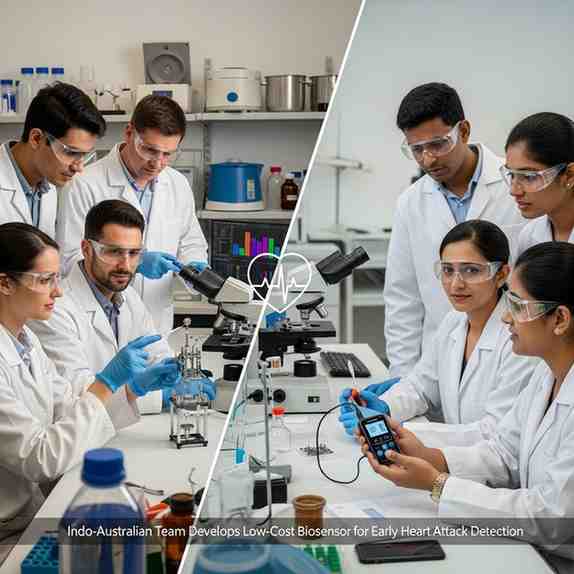
Breakthrough in Early Cardiac Screening Technology
Researchers have developed a flexible, low-cost biosensor capable of rapidly detecting myoglobin , a key cardiac biomarker associated with the early stages of heart attack . The innovation is expected to enhance early diagnosis and timely intervention, particularly in resource-constrained healthcare settings where access to advanced cardiac testing remains limited.
Indo-Australian Academic Collaboration
The biosensor was developed by doctoral researcher Mohsina Afrooz through a joint research programme involving Birla Institute of Technology and Science Pilani Hyderabad and RMIT University .
The collaboration combines strengths in materials science, biosensing, and biomedical engineering , reflecting the growing depth of Indo-Australian cooperation in healthcare innovation and advanced research .
Graphene-Based Detection of Myoglobin
The newly designed biosensor is graphene-based , leveraging the material’s exceptional electrical conductivity and sensitivity. It targets myoglobin , a protein released into the bloodstream within hours of cardiac muscle injury .
Clinically, myoglobin is one of the earliest detectable biomarkers of myocardial damage, often appearing before traditional markers such as troponin. Rapid identification can therefore play a crucial role in early diagnosis, risk stratification, and faster treatment decisions .
Portable, Affordable and Point-of-Care Ready
Conventional cardiac diagnostic tests are typically laboratory-intensive, time-consuming, and expensive , limiting their use in emergency or rural settings. In contrast, the newly developed biosensor is:
-
Lightweight and flexible
-
Economical to fabricate
-
Suitable for portable and point-of-care testing
An Indian patent has been filed for the technology, underlining its translational potential. Lead investigator Sanket Goel noted that the goal is to bridge the gap between advanced sensing research and affordable, deployable cardiac diagnostics .
Relevance for Rural and Emergency Healthcare
The biosensor is particularly suited for rural hospitals, ambulances, emergency departments, and low-resource clinics , where rapid decision-making is critical and laboratory infrastructure may be absent.
According to the research team, the broader aim is to make heart attack detection quicker, simpler, and scalable , thereby improving survival outcomes. The findings have been published in the international peer-reviewed journal IEEE Sensors Letters , confirming the study’s scientific credibility.
Exam-Focused Key Points
-
Myoglobin is an early cardiac biomarker released after heart muscle injury
-
Graphene is used in biosensors due to high conductivity and sensitivity
-
Point-of-care diagnostics reduce reliance on central laboratories
-
Research reflects strong Indo-Australian collaboration
-
Technology supports affordable and rapid
Month: Current Affairs - February 06, 2026
Category: Science & Technology | Health Technology