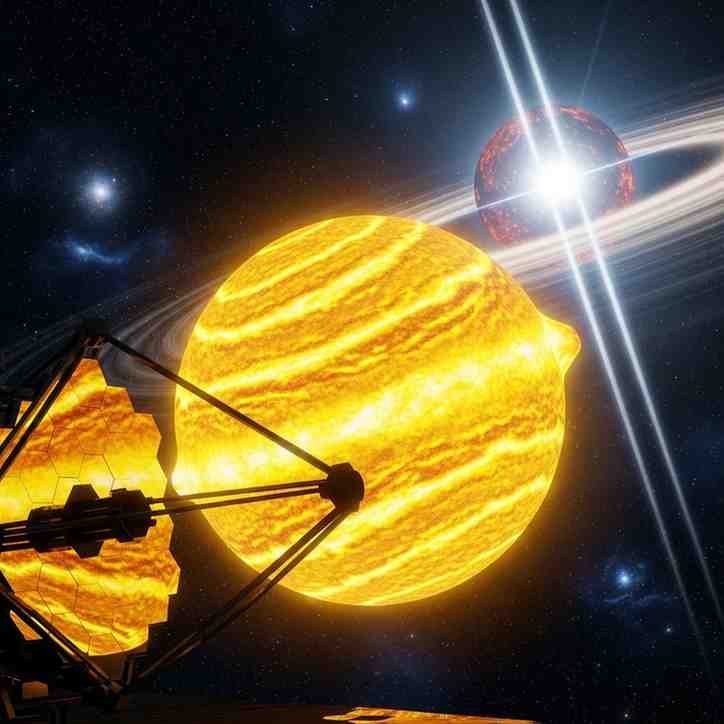
PSR J2322-2650b: An Extreme Carbon-Rich World Revealed by James Webb
The James Webb Space Telescope (JWST) has uncovered one of the most extreme and scientifically puzzling exoplanets ever observed. Known as PSR J2322-2650b , the planet lies around 2,000 light-years from Earth and exhibits a striking lemon-like shape , challenging existing ideas about planetary structure, composition, and survival in hostile cosmic environments.
An Unusual Orbit Around a Pulsar
Unlike most known exoplanets that orbit normal stars, PSR J2322-2650b circles a millisecond pulsar —the ultra-dense remnant of a massive star. Although comparable to the Sun in mass, the pulsar is compressed into a city-sized object and emits intense radiation. The planet completes a full orbit in just 7.8 hours , at a distance of roughly one million miles , placing it under enormous gravitational and radiative stress.
Extreme Heat and Tidal Deformation
Due to its tight orbit, the planet experiences extraordinary temperatures. Webb observations indicate around 3,700°F on the pulsar-facing side , while the opposite side cools to nearly 1,200°F . Such extreme temperature contrasts, combined with the pulsar’s gravity, stretch the planet along its orbit. This tidal distortion is responsible for its unusual, non-spherical, lemon-like appearance.
A Rare Carbon-Dominated Atmosphere
JWST’s infrared instruments revealed an atmosphere unlike any previously studied. Instead of water vapour, oxygen, or methane, the atmosphere is rich in carbon compounds such as C₂ and C₃ , along with helium . The near absence of oxygen and nitrogen makes PSR J2322-2650b chemically distinct from more than 150 exoplanets analysed so far.
What to Note for Exams?
-
PSR J2322-2650b orbits a millisecond pulsar , not a regular star.
-
Orbital period is about 7.8 hours .
-
The planet shows carbon-rich chemistry with helium dominance.
-
Strong tidal forces distort it into a lemon-like shape .
Scientific Significance
Webb data also hint at carbon soot clouds and possible carbon crystallisation deep inside the planet. Existing planetary models struggle to explain how such a world formed or survived, making PSR J2322-2650b a crucial case study in understanding planetary extremes.
Month: Current Affairs - December 22, 2025
Category: Science & Technology, Space