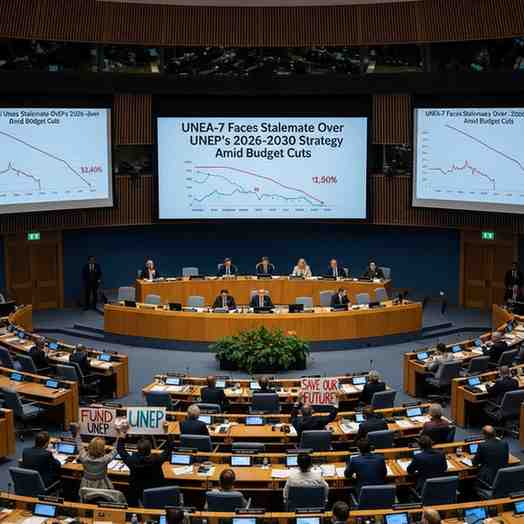
UNEA-7 Opens in Nairobi Amid Deep Divisions Over UNEP’s Medium-Term Strategy
The seventh UN Environment Assembly (UNEA-7) has begun in Nairobi under tense circumstances, with member states still unable to agree on UNEP’s Medium-Term Strategy (MTS) for 2026–2030. The MTS serves as the organisation’s core mandate, shaping global action on climate change, biodiversity protection, pollution control and land restoration. Despite months of consultations, several delegations are demanding that the text be reopened, while others argue that renegotiation would delay urgently needed guidance for UNEP’s work.
Budget Pressures Add Complexity to Talks
The Assembly convenes at a time of significant financial pressure on UNEP. Reductions in contributions from key donors—particularly the United States—have resulted in a 20% drop in the regular budget and an 11–12% decline in the Environment Fund. These cuts have strained core operations, reduced staffing capacity and increased dependence on unpredictable voluntary funding. As a result, countries are pushing for alignment between UNEP’s ambitions and its shrinking financial resources.
Resolutions Face Uncertain Future
Only 15 draft resolutions remain in active negotiation, with several others withdrawn due to lack of consensus. Proposals on wildfire management and glacier protection are moving forward but still face political obstacles. Observers note that tensions among major geopolitical blocs risk slowing progress on critical issues such as chemicals regulation, plastic pollution and cross-border environmental crime.
Exam Oriented Facts
-
UNEA-7 is debating UNEP’s Medium-Term Strategy for 2026–2030.
-
UNEP reports a 20% budget cut and an 11–12% decline in Environment Fund contributions.
-
15 resolutions remain on the negotiation table.
-
Key thematic areas: climate, biodiversity, pollution, land restoration.
Month: Current Affairs - Dec 11, 2025
Category: UN Environment Assembly (UNEA)