EX Hydrae Study: How X-Ray Polarimetry Reveals White Dwarf Geometry
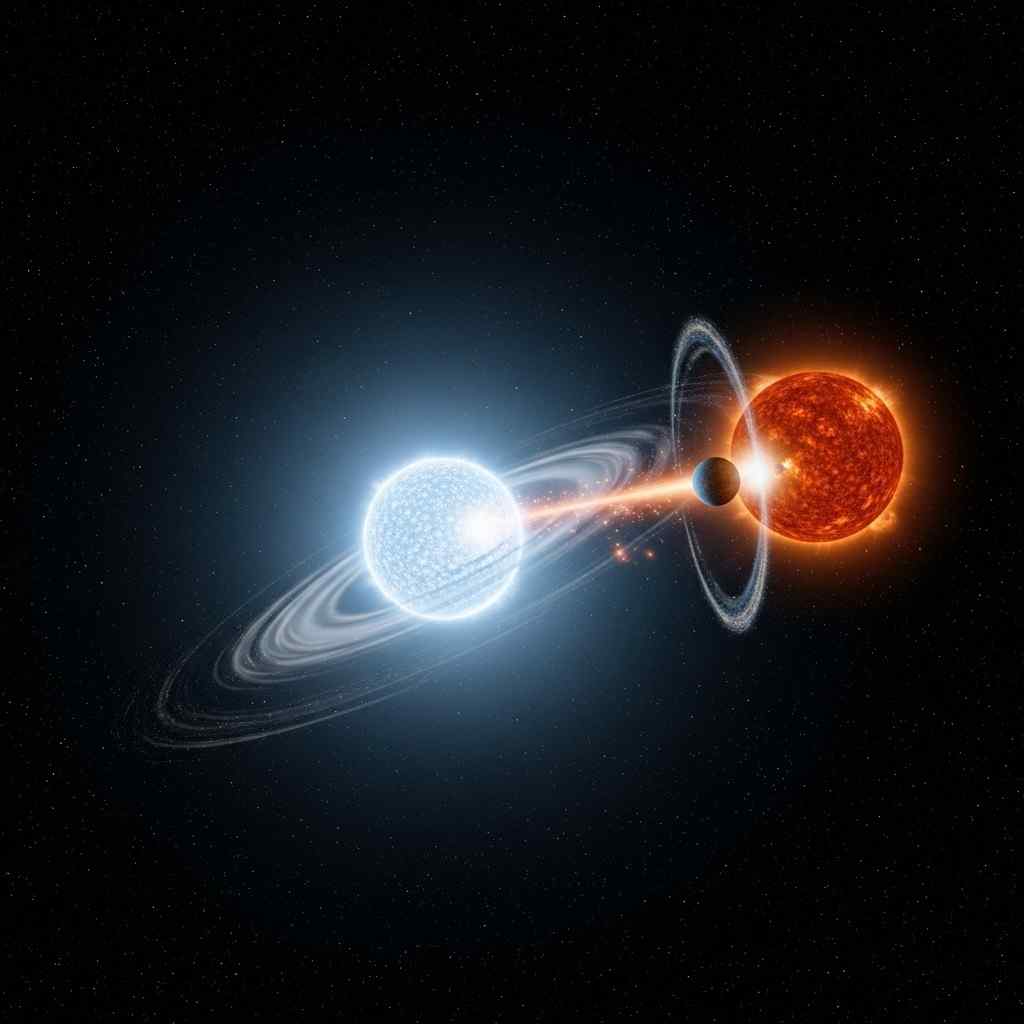
NASA has achieved a subtle yet major breakthrough in space science by revealing the internal structure of a white dwarf system in unprecedented detail. Using the Imaging X-ray Polarimetry Explorer (IXPE) , scientists have gone beyond measuring brightness to directly probe geometry and physical processes inside such a system. The observations focused on EX Hydrae , a compact stellar remnant locked in a close binary orbit.
EX Hydrae and White Dwarfs
EX Hydrae lies about 200 light-years away in the Hydra constellation. It is a white dwarf—the dense remnant formed when a Sun-like star exhausts its nuclear fuel. Although roughly Earth-sized, a white dwarf can have a mass comparable to the Sun. In this binary system, EX Hydrae steadily pulls gas from a nearby companion star, generating intense X-ray radiation.
Intermediate Polars and Extreme Physics
The system belongs to a rare class known as intermediate polars . In these systems, the white dwarf’s magnetic field is strong enough to disturb the accretion disc but not strong enough to destroy it completely. Gas spirals inward before being funnelled along magnetic field lines toward the star’s surface. As this matter crashes down, it heats to tens of millions of degrees , emitting powerful X-rays.
What IXPE Revealed
Unlike conventional X-ray telescopes, IXPE measures X-ray polarisation , revealing how radiation is scattered and redirected. Observations spanning nearly a week in 2024 allowed scientists to estimate the height of the superheated gas column , which rises almost 2,000 miles above the white dwarf’s surface . The data also showed that some X-rays are reflected off the star’s surface before escaping into space—details that previously required heavy theoretical assumptions.
Implications for Astrophysics
The study, led by researchers from Massachusetts Institute of Technology and published in the Astrophysical Journal , demonstrates how polarimetry can uncover structures too distant to image directly. As IXPE continues studying neutron stars and black holes, this approach is expected to refine models of matter under extreme gravity and magnetism.
Important Facts for Exams
-
White dwarfs are dense remnants of Sun-like stars
-
IXPE measures X-ray polarisation , not just intensity
-
Intermediate polars have moderately strong magnetic fields
-
EX Hydrae is located in the Hydra constellation
Month: Current Affairs - Jan 08, 2026
Category: Science & Technology