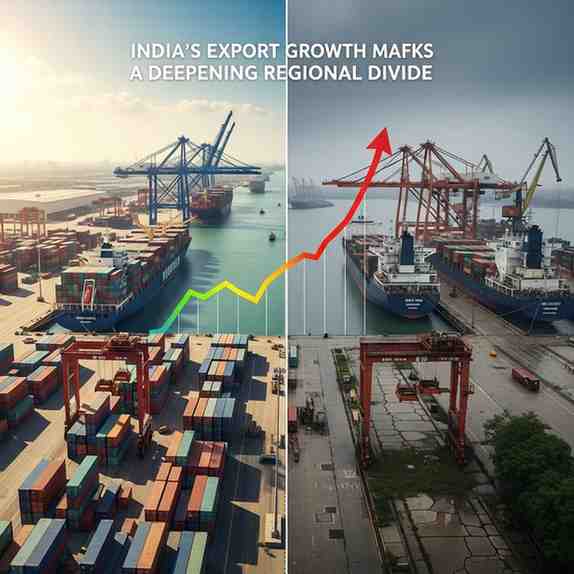
Export Numbers and the Illusion of Uniform Growth
Despite a weakening rupee and slowing global trade, India’s export figures continue to appear resilient at the national level. However, a closer reading of the RBI Handbook of Statistics on Indian States 2024–25 reveals a structurally uneven picture. Export growth in India is becoming increasingly concentrated, raising concerns about its role as a driver of inclusive development.
A Hardening Core–Periphery Structure
Five States — Maharashtra, Gujarat, Tamil Nadu, Karnataka and Uttar Pradesh — now account for nearly 70% of India’s exports , up from about 65% five years ago. Rising export concentration, reflected in a higher Herfindahl–Hirschman Index (HHI) , indicates that economic activity is clustering rather than dispersing. Coastal and near-coastal regions are integrating into global value chains, while much of northern and eastern India is falling behind.
Global Trade and Economic Complexity
This divergence is reinforced by global trends. Merchandise trade growth has slowed to 0.5–3% , while the top ten exporting nations control over half of global trade . In such conditions, global capital favours regions with economic complexity — skilled labour, dense supplier networks and strong institutions — rather than low-cost labour alone. India’s leading export states occupy these complex “product spaces”; the hinterland largely does not.
Export Growth Without Jobs
The employment implications are stark. Data from the Annual Survey of Industries 2022–23 shows fixed capital rising faster than employment, with capital per worker reaching ₹23.6 lakh . Manufacturing is becoming capital-intensive, weakening the traditional link between exports and mass job creation. The PLFS confirms this, with manufacturing employment stagnant at around 12% .
Rethinking Exports as a Development Tool
Exports in India increasingly reflect pre-existing capacity rather than driving convergence. Treating export growth as a proxy for inclusive development risks confusing outcomes with instruments, calling for a deeper rethink of regional and industrial policy.
Important Facts for Exams
-
Five states contribute ~70% of India’s exports
-
Rising HHI signals export concentration
-
Manufacturing employment remains near 12%
-
Capital intensity in industry is increasing
Month: Current Affairs - Dec 25, 2025
Category: Indian Economy, Regional Development