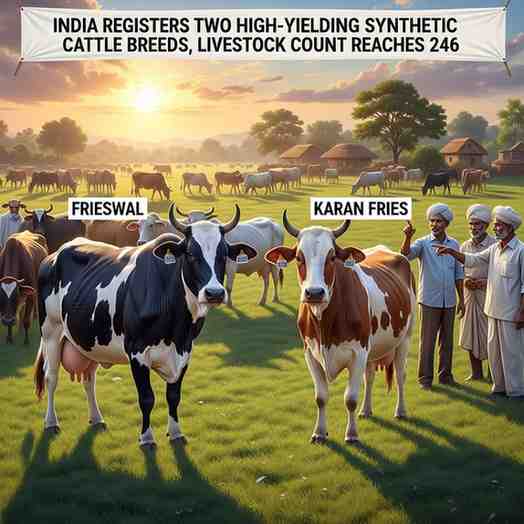
India Adds Two High-Yielding Synthetic Cattle Breeds, Registered Livestock Tally Rises to 246
India has taken another step towards strengthening its dairy and livestock sector with the formal registration of two high-yielding synthetic cattle breeds , each capable of producing over 3,000 kg of milk in a standard 10-month lactation period . With these additions, the total number of officially registered livestock and poultry breeds in the country has increased to 246 , highlighting India’s dual focus on boosting productivity while safeguarding indigenous genetic diversity.
Recognition of New Livestock and Poultry Breeds
The registration certificates for 16 newly recognised livestock and poultry breeds were presented by Union Agriculture Minister Shivraj Singh Chouhan at a programme organised by the Indian Council of Agricultural Research through its National Bureau of Animal Genetic Resources.
Official registration grants legal status to breeds, enabling structured conservation, selective breeding programmes, and eligibility for government-supported development schemes tailored to regional needs.
Synthetic Breeds Driving Dairy Productivity
The two newly registered synthetic cattle breeds are Karan Fries and Vrindavani , both developed through carefully planned cross-breeding programmes.
-
Karan Fries was developed by the National Dairy Research Institute by crossing indigenous Tharparkar cattle with high-yielding Holstein-Friesian bulls.
-
Vrindavani was developed by the Indian Veterinary Research Institute , blending genetics from Holstein-Friesian, Brown Swiss and Jersey cattle with the indigenous Hariana breed.
Compared to most indigenous cattle, which typically yield 1,000–2,000 kg of milk per lactation , these synthetic breeds offer significantly higher productivity, making them important for meeting India’s growing dairy demand.
Stress on Indigenous Breed Conservation
Alongside productivity gains, ICAR Director General M L Jat emphasised the need to conserve indigenous animal genetic resources, particularly in the face of climate change and rising disease risks.
Of the 16 newly registered breeds, 14 are indigenous , including Medini and Rohikhandi cattle, Melghati buffalo, Palamu and Udaipuri goats, and Nagami Mithun. Several poultry and waterfowl breeds from eastern and southern India were also included, reflecting the country’s vast agro-ecological diversity.
Important Facts for Exams
-
India has 246 registered livestock and poultry breeds .
-
Karan Fries and Vrindavani are recognised synthetic dairy cattle breeds.
-
ICAR has been undertaking systematic breed registration since 2008 .
-
Breed registration provides legal protection and supports targeted development schemes.
Policy Significance and Sectoral Impact
According to ICAR officials, synthetic breeds contribute to higher milk productivity and dairy self-sufficiency , while indigenous breeds offer resilience to heat stress, diseases, and climatic variability . Currently, India has 242 indigenous and four synthetic breeds officially registered.
Month: Current Affairs - January 16, 2026
Category: Animal Husbandry | Dairy Sector