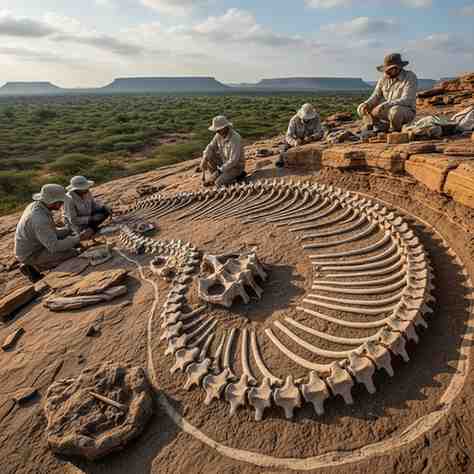
Fossil Discovery from a Hot Prehistoric World
Rock formations in western India have revealed striking evidence of a prehistoric ecosystem shaped by extreme heat and continental movement. Fossil remains unearthed in Gujarat point to the existence of an exceptionally large snake that lived around 47 million years ago during the early Eocene epoch . The discovery has generated scientific interest as it may challenge long-held assumptions about which species qualifies as the largest snake to have ever lived.
Eocene Climate and Reptilian Gigantism
The early Eocene was among the warmest periods in Earth’s geological history , characterised by tropical climates and minimal polar ice. Such conditions favoured ectothermic (cold-blooded) animals , allowing reptiles to attain enormous sizes. The Gujarat fossils were recovered from sedimentary deposits laid down during this climatic phase, supporting the idea that global warmth played a crucial role in reptilian gigantism.
What the Vertebrae Indicate
The fossil material mainly consists of well-preserved vertebrae , which are critical for estimating snake size. Researchers found the vertebrae to be unusually wide, thick and robust . Anatomical comparisons place the species within the madtsoiid lineage , an extinct group already known for producing some of the largest snakes in evolutionary history. The structure of the vertebrae suggests not only great length but also exceptional body mass and muscular strength.
Rethinking “The Largest Snake”
Identifying the largest snake is complicated by the rarity of complete skeletons. Traditionally, length has dominated such comparisons. However, the Gujarat fossils indicate that bulk and overall body strength are equally significant, suggesting that multiple forms of snake gigantism may have evolved independently across regions and time periods.
Continental Drift and Ancient Ecosystems
During the Eocene, Gujarat supported river systems, dense forests and abundant prey , including early mammals and large fish. Madtsoiid fossils found across Africa, South America and Australia reflect ancient land connections from the Gondwana supercontinent. The Gujarat snake strengthens evidence that India carried its own megafauna as it drifted northward, reshaping understanding of prehistoric ecosystems and continental evolution.
Important Facts for Exams
-
The Eocene epoch was one of the warmest geological periods
-
Madtsoiids were an extinct group of giant snakes
-
Vertebrae are key indicators of snake body size
-
India was once part of Gondwana
Month: Current Affairs - December 27, 2025
Category: Environment & Ecology