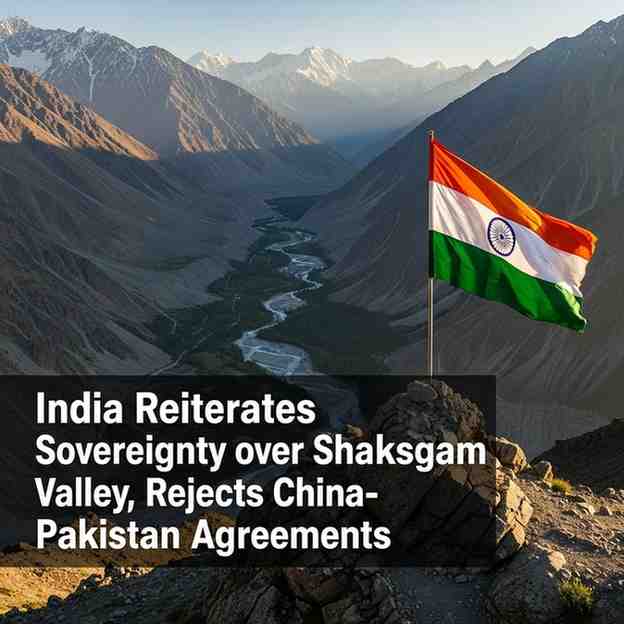
India Opposes CPEC Through Shaksgam Valley, Calls 1963 China–Pakistan Pact Illegal
India has once again firmly asserted that the Shaksgam Valley is an integral part of its territory, rejecting any infrastructure projects, agreements, or understandings that involve what it considers illegally occupied land. The statement underscores New Delhi’s long-standing opposition to both the China–Pakistan understanding over the region and the China-Pakistan Economic Corridor (CPEC) , which India views as violations of its sovereignty.
India’s Stand on Shaksgam Valley
Responding to media queries, Ministry of External Affairs spokesperson Randhir Jaiswal stated that the Shaksgam Valley is part of the Indian Union Territory of Ladakh . He reiterated that India has never recognised the 1963 agreement between China and Pakistan concerning the region.
According to India, Pakistan had no legal authority to transfer or negotiate territory that New Delhi considers its own. As such, any claims or projects based on that agreement are viewed as invalid and unacceptable.
Rejection of the 1963 China–Pakistan Boundary Agreement
The MEA reiterated that the China–Pakistan Boundary Agreement of 1963 is illegal and void from India’s perspective. New Delhi has consistently maintained that arrangements made by Pakistan over areas under its illegal occupation carry no legal standing.
India has conveyed this position to Beijing on multiple occasions, stressing that bilateral understandings between China and Pakistan cannot alter India’s territorial claims or override principles of sovereignty and international law.
Opposition to the China-Pakistan Economic Corridor
India also restated its categorical opposition to the China-Pakistan Economic Corridor , a flagship project under China’s Belt and Road Initiative. The MEA noted that segments of CPEC pass through Indian territory under Pakistani occupation , making the project fundamentally unacceptable to New Delhi.
India has repeatedly urged China to respect its sovereignty and territorial integrity , emphasising that economic or infrastructure development cannot legitimise disputed or illegally held territories.
Strategic and Diplomatic Significance
India’s renewed assertion reflects a broader and consistent diplomatic strategy: to place its territorial claims clearly on record in bilateral and international forums. By reiterating its position on Shaksgam Valley and CPEC, New Delhi seeks to deter any third-party legitimisation of disputed arrangements and reinforce the principle that development initiatives cannot override questions of sovereignty.
The statement also signals policy continuity, ensuring that India’s stance remains unambiguous amid evolving regional geopolitics.
Quick Facts for Exams
-
Shaksgam Valley lies north of the Siachen Glacier and is part of the larger Kashmir region.
-
The China–Pakistan Boundary Agreement (1963) is not recognised by India.
-
CPEC links China’s Xinjiang region with Pakistan’s Gwadar Port.
-
India opposes all projects in Pakistan-occupied territories on sovereignty grounds.
Month: Current Affairs - January 10, 2026
Category: CPEC, and diplomatic messaging