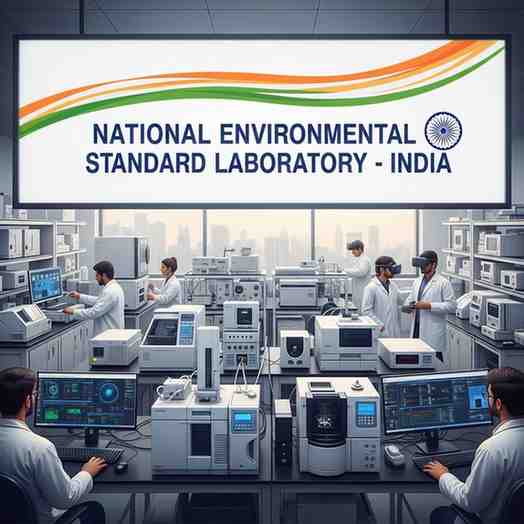
NESL at CSIR-NPL: India’s Push for Reliable Air Pollution Standards and Clean Air Governance
India has taken a major step toward strengthening environmental governance and scientific self-reliance with the establishment of the National Environmental Standard Laboratory (NESL) . The new facility is designed to support the development, testing, and certification of indigenous air pollution monitoring instruments , reducing dependence on imported equipment and foreign certification systems that often do not reflect Indian environmental realities.
A Landmark Facility for Environmental Standards
The NESL has been set up at the CSIR–National Physical Laboratory (CSIR-NPL) in New Delhi. With this, India becomes only the second country in the world after the United Kingdom to host a National Environmental Standard Laboratory. The facility was inaugurated during the 80th Foundation Day celebrations of CSIR-NPL.
As India’s apex metrology institution, CSIR-NPL is the custodian of national measurement standards. Housing NESL within this institution ensures that environmental measurements are anchored in scientifically robust and internationally comparable standards, while still being tailored to domestic needs.
Why Imported Monitoring Systems Fall Short
At present, a large proportion of air quality monitoring instruments used in India are imported and certified by agencies based in Europe or the United States. These certifications are carried out under environmental conditions—such as moderate dust levels, stable humidity, and relatively uniform pollution profiles—that differ sharply from those found in Indian cities.
Indian conditions often involve high dust loads, extreme temperature variations, and complex pollution mixtures . Over time, these factors can compromise the accuracy, durability, and reliability of imported instruments. Scientists have repeatedly flagged that such mismatches can lead to inconsistent data and reduced confidence in long-term air quality assessments.
NESL’s Role in Calibration and Data Credibility
The National Environmental Standard Laboratory will address these gaps by developing testing, calibration, and validation facilities specifically suited to Indian environmental conditions . Instruments can now be evaluated for performance under realistic operating scenarios, helping detect measurement anomalies and improving the overall credibility of air quality data.
NESL will support equipment manufacturers, industries, urban local bodies, and municipal agencies by enabling in-country validation of monitoring devices. This is expected to promote the production of standardised, reliable, and affordable air pollution monitoring instruments within India.
Strengthening National Clean Air and Urban Programmes
Reliable data is the foundation of effective environmental policy. NESL-certified instruments will strengthen air quality management under initiatives such as the National Clean Air Programme (NCAP) , industrial emission audits, and smart city monitoring networks.
By ensuring that monitoring systems are both accurate and locally validated, the laboratory will help policymakers design targeted interventions, track progress more effectively, and improve public trust in air quality data.
A Step Toward Self-Reliance in Environmental Science
Beyond pollution control, the NESL aligns with India’s broader goals of self-reliance, scientific capacity building, and evidence-based policymaking . Domestic certification reduces costs, shortens approval timelines, and encourages innovation among Indian manufacturers.
Quick Facts for Exams
-
NESL is the world’s second National Environmental Standard Laboratory, after the UK.
-
It is
Month: Current Affairs - January 09, 2026
Category: Air Pollution Monitoring India