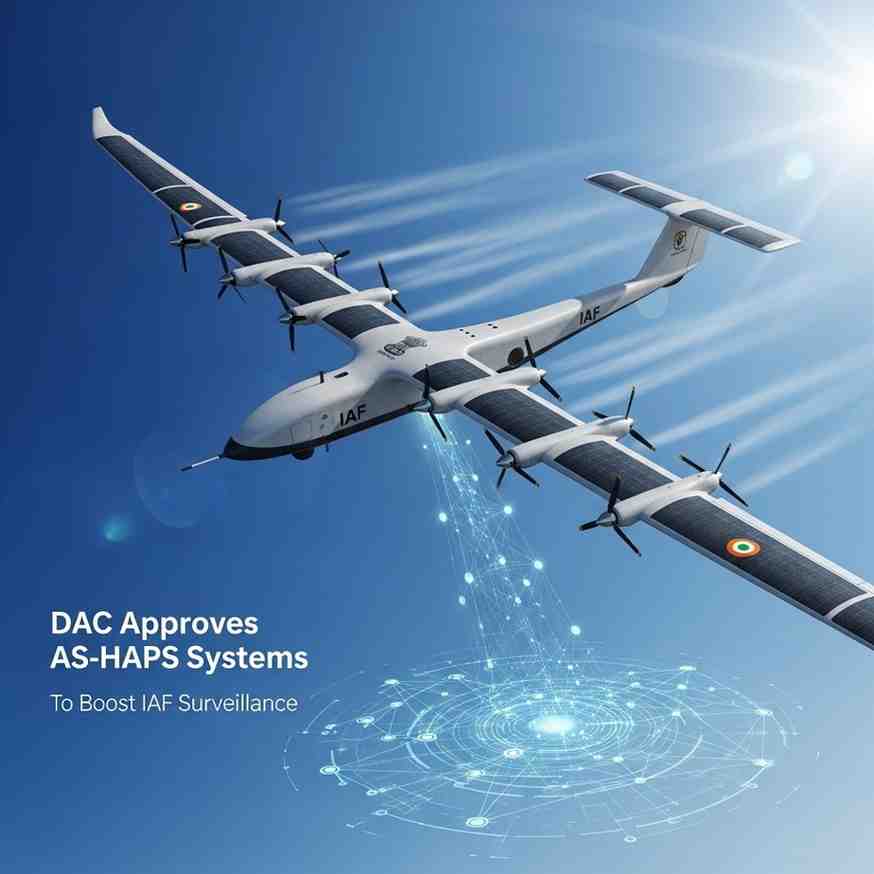
High-Altitude Pseudo-Satellites to Strengthen India’s ISR Network
The Defence Acquisition Council (DAC) has granted Acceptance of Necessity (AoN) for the procurement of Air-Ship Based High-Altitude Pseudo-Satellite (AS-HAPS) systems for the Indian Air Force. The approval forms part of a broader capital acquisition package valued at ₹3.60 lakh crore , which also includes Rafale fighter aircraft and advanced missile systems. Estimated at approximately Rs 15,000 crore , the AS-HAPS programme is expected to substantially enhance India’s Intelligence, Surveillance and Reconnaissance (ISR) capabilities.
The proposal will now progress to cost negotiations before being submitted to the Cabinet Committee on Security (CCS) for final clearance.
Understanding High-Altitude Pseudo-Satellites (HAPS)
High-Altitude Pseudo-Satellites are solar-powered unmanned aerial platforms operating in the stratosphere at altitudes of 18–20 km . Unlike satellites orbiting hundreds of kilometres above Earth, HAPS platforms can remain airborne for extended durations, often weeks or months , using solar panels and onboard energy storage systems.
They deliver satellite-like services, including persistent observation and telecommunications, but at lower deployment costs and with greater operational flexibility.
Strategic Surveillance Requirements
The operational value of HAPS gained prominence following events such as the Doklam standoff , which highlighted limitations in continuous border monitoring. Conventional UAVs have endurance constraints, while low-earth orbit satellites lack stationary persistence.
HAPS platforms bridge this gap by enabling continuous regional surveillance , real-time ISR, Electronic Intelligence (ELINT), and secure communications support.
Indigenous Development Efforts
India is advancing domestic HAPS capability through the National Aerospace Laboratories (NAL), Bengaluru . Prototype trials at the Challakere Aeronautical Test Range demonstrated progress towards a full-scale platform targeted for deployment by 2027. Defence public sector units and start-ups are also contributing under initiatives such as iDEX .
Exam-Focused Points
-
HAPS altitude → 18–20 km (stratosphere)
-
Power source → Solar + energy storage
-
Role → Persistent ISR & ELINT
-
AoN → Initial stage of defence procurement
-
Challakere ATR → Karnataka
Month: Current Affairs - February 15, 2026
Category: Security | Aerospace Technology