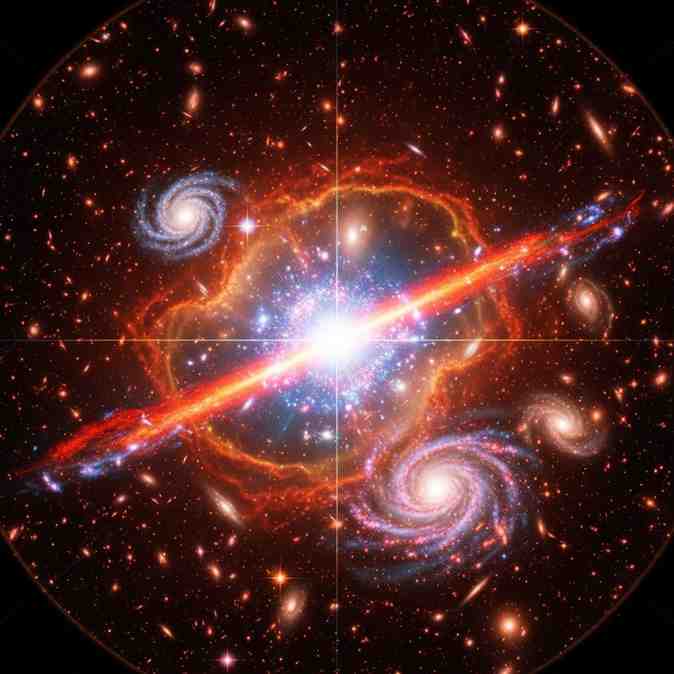
James Webb Space Telescope Spots Earliest Supernova, Illuminating the Universe’s Early Evolution
The James Webb Space Telescope (JWST) has identified the earliest known supernova , offering an unprecedented window into stellar death during the universe’s first billion years. The discovery provides crucial evidence of how massive early stars lived brief, explosive lives and rapidly enriched young galaxies with elements essential for future planets and life.
A Supernova From the Cosmic Dawn
Astronomers detected the event by observing faint but consistent brightness variations in a compact, distant galaxy formed shortly after the Big Bang . Using Webb’s near-infrared instruments , researchers compared images taken at different times and reconstructed the fading light pattern of a stellar explosion. This period coincides with intense early star formation, when galaxies were dominated by massive, short-lived stars.
Explosion Signature and Stellar Origins
The light curve strongly indicates a core-collapse supernova , triggered when a massive star exhausted its nuclear fuel and collapsed under its own gravity. The resulting explosion expelled heavy elements—such as carbon, oxygen and iron—into surrounding space. These early enrichment processes accelerated chemical evolution and laid the groundwork for later generations of stars and planetary systems.
Role of the Host Galaxy Environment
The host galaxy appears dense and rapidly star-forming, matching theoretical models of early cosmic environments. Such galaxies produced large numbers of massive stars, leading to frequent energetic supernovae that reshaped gas clouds, influenced gravitational dynamics and regulated future star formation. Studying these surroundings helps scientists understand how primitive galaxies evolved into the complex systems seen today.
Implications for Cosmic Evolution Models
This discovery suggests that stellar birth–death cycles began earlier and more intensely than previously believed. By capturing such distant explosions, JWST is refining timelines for chemical enrichment, galaxy growth and matter distribution—paving the way for detecting even older stellar explosions from the universe’s infancy.
Exam Point
-
JWST detected the earliest recorded supernova using near-infrared imaging.
-
The explosion occurred within the first billion years after the Big Bang.
-
Evidence indicates a core-collapse supernova of a massive early star.
-
Early supernovae supplied heavy elements vital for planets and complex chemistry.
Month: Current Affairs - Dec 13, 2025
Category: Astronomy, Space Science