Underground Fungal Networks Earn Global Recognition for Climate Science Breakthrough
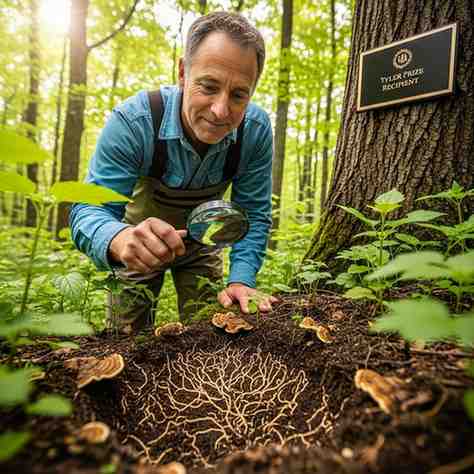
American evolutionary biologist Toby Kiers has been honoured with the Tyler Prize for Environmental Achievement for reshaping scientific understanding of the vast underground fungal systems that quietly sustain ecosystems and regulate Earth’s climate. Her work has brought global attention to mycorrhizal fungi—organisms once ignored, now recognised as pillars of planetary health.
Invisible Networks with Global Climate Impact
Beneath forests, grasslands and croplands lies an immense web of mycorrhizal fungi intertwined with plant roots. These fungi form mutualistic partnerships with plants, supplying nutrients like phosphorus and nitrogen in exchange for carbon-rich compounds. Research shows that these underground systems collectively absorb over 13 billion tonnes of carbon dioxide annually , positioning them among the planet’s most powerful natural climate stabilisers.
Redefining the Role of Fungi in Ecosystems
Earlier ecological thinking treated fungi as passive assistants to plants. Kiers’ research overturned this assumption, revealing fungi as active decision-makers that influence nutrient flows, plant productivity and ecosystem resilience. Her findings reframed mycorrhizal networks as a form of living infrastructure—essential for soil fertility, biodiversity and long-term climate balance.
A Biological Marketplace Below the Surface
One of Kiers’ most influential contributions was demonstrating that fungi operate through market-like behaviour . In controlled experiments, fungi were shown to allocate nutrients strategically, favouring plants that offered better carbon returns. This adaptive exchange occurs without a brain or nervous system, challenging conventional ideas about intelligence and coordination in living systems.
Exam-Focused Key Points
-
Mycorrhizal fungi form symbiotic relationships with plant roots.
-
These networks help sequester a significant share of global carbon emissions.
-
Arbuscules are specialised fungal structures enabling nutrient exchange.
-
Underground biodiversity often remains outside formal conservation zones.
-
The Tyler Prize recognises exceptional contributions to environmental science.
Mapping the Underground for Conservation
Building on her ecological research, Kiers co-led the creation of a global Underground Atlas charting the distribution of mycorrhizal fungi. The project revealed that many fungal biodiversity hotspots lack legal protection. To bridge this gap, she helped establish the Society for the Protection of Underground Networks , advocating for fungi to be included in conservation laws and environmental governance.
Why the Discovery Matters
By illuminating the hidden systems that sustain plant life and regulate climate, Kiers’ work has expanded the boundaries of conservation science. It underscores that protecting forests and soils also means safeguarding the unseen fungal networks beneath them—an insight increasingly vital as the world confronts climate change and ecosystem degradation.
Month: Current Affairs - Jan 14, 2026
Category: Biodiversity Conservation