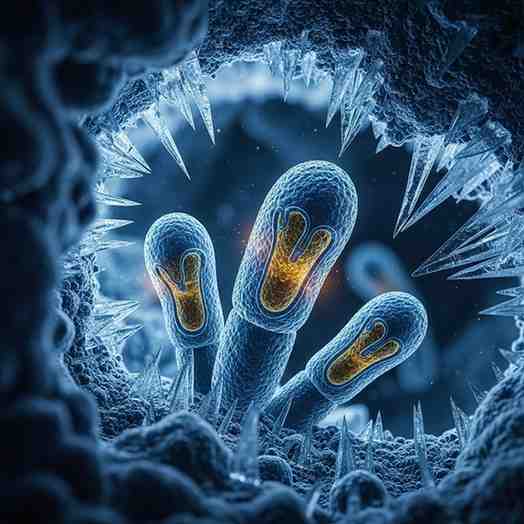
5,000-Year-Old Microbe Highlights Climate and Health Concerns
Scientists have uncovered a 5,000-year-old bacterium preserved in underground ice in Romania that exhibits resistance to several modern antibiotics. The strain was extracted from Scărișoara Ice Cave , a natural archive of ancient ice layers. The discovery has intensified discussions about biological risks associated with melting ice in a warming climate.
Recovery from Deep Ice Layers
Researchers drilled a 25-metre ice core from the cave’s “Great Hall,” representing nearly 13,000 years of ice accumulation. To eliminate contamination, samples were processed under sterile conditions and transported frozen for laboratory analysis. Multiple bacterial strains were isolated, sequenced, and studied.
The most notable strain, Psychrobacter SC65A.3 , belongs to a genus of cold-adapted bacteria previously associated with infections in humans and animals. Despite its ancient origin, the bacterium demonstrated remarkable resilience under modern medical testing.
Resistance to Contemporary Antibiotics
Genomic analysis revealed over 100 genes linked to antimicrobial resistance. When tested against 28 antibiotics spanning 10 drug classes, the bacterium proved resistant to 10. These included commonly prescribed medications such as trimethoprim, clindamycin, and metronidazole.
The findings challenge the assumption that antibiotic resistance arises solely from modern misuse. Instead, they reinforce evidence that resistance mechanisms have long existed in natural microbial ecosystems.
Climate Change and Genetic Reservoirs
Scientists stress that ancient microbes do not inherently signal imminent disease threats. However, thawing glaciers, permafrost, and ice caves may release dormant organisms or resistance genes capable of transferring to present-day bacteria.
A frequently cited example is the 2016 Siberian heatwave, which thawed permafrost and triggered an anthrax outbreak after decades of dormancy. Such events illustrate how rising temperatures can revive long-isolated pathogens.
Important Facts for Exams
-
Glaciers and ice sheets cover ~10% of Earth’s land surface.
-
Antibiotic resistance can evolve naturally in environmental microbes.
-
Psychrobacter species are cold-adapted extremophiles.
-
Permafrost thaw has previously reactivated dormant pathogens.
Scientific Significance and Potential
Beyond risk assessment, the bacterium’s genome revealed genes with antimicrobial potential and hundreds of uncharacterised sequences. Cold-adapted microbes are valuable in biotechnology, offering novel enzymes and bioactive compounds. Researchers emphasise that strict biosafety protocols remain essential during such investigations.
Month: Current Affairs - February 18, 2026
Category: Science & Technology | Microbiology