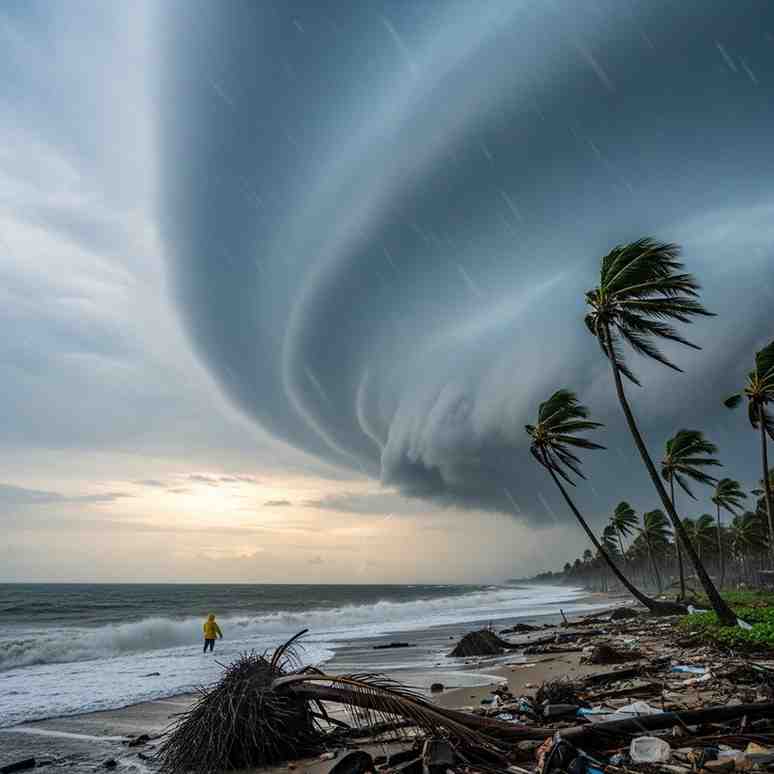
Cyclone Bakung’s Indirect Influence on South India
Unusual winter-like conditions are being felt across parts of South India as Cyclone Bakung intensifies over the Indian Ocean. Although the cyclone is not projected to make landfall over Indian territory, its presence has altered regional wind circulation and pressure systems, leading to cooler temperatures and atypical weather for this time of year.
Present Condition of Cyclone Bakung
Cyclone Bakung developed over the southwest Indian Ocean and continues to strengthen as it moves away from the Indonesian maritime region. Meteorological agencies indicate wind speeds exceeding 60 kmph , with dense cloud formations near the equatorial zone. While the system is expected to gradually weaken over open waters, its interaction with surrounding atmospheric systems has already begun influencing weather far beyond its core zone.
Shift in Wind Patterns and Cooling Effect
The most visible impact is the inflow of cold northeasterly winds into peninsular India. States such as Karnataka, Andhra Pradesh, and Tamil Nadu are experiencing steady winds of around 10–12 kmph , resulting in cooler mornings and nights. This drop in temperature is occurring without widespread rainfall, making the phenomenon unusual compared to typical cyclone-related weather events.
Urban Temperature Changes and Air Quality
Cities including Bengaluru have recorded a marked fall in minimum temperatures, with forecasts suggesting lows between 12°C and 14°C over the coming days. The chill is expected to persist for nearly a week. In some urban areas, reduced atmospheric mixing has led to stagnation of pollutants, contributing to a temporary decline in air quality. Health experts advise caution for vulnerable groups such as children and senior citizens.
Marine Conditions and Precautions
Coastal regions of southern Tamil Nadu and parts of Andhra Pradesh are witnessing rough sea conditions, with higher wave activity reported in the Gulf of Mannar . Fishermen have been advised to avoid venturing into affected waters as a precautionary measure.
Exam Oriented Facts
-
Cyclones can influence regional weather without landfall .
-
Northeasterly winds often cause winter-like conditions in South India.
-
BMKG is Indonesia’s national meteorological agency.
-
Cyclone intensity depends on wind speed and central pressure .
Month: Current Affairs - December 14, 2025
Category: tropical cyclones, climate variability