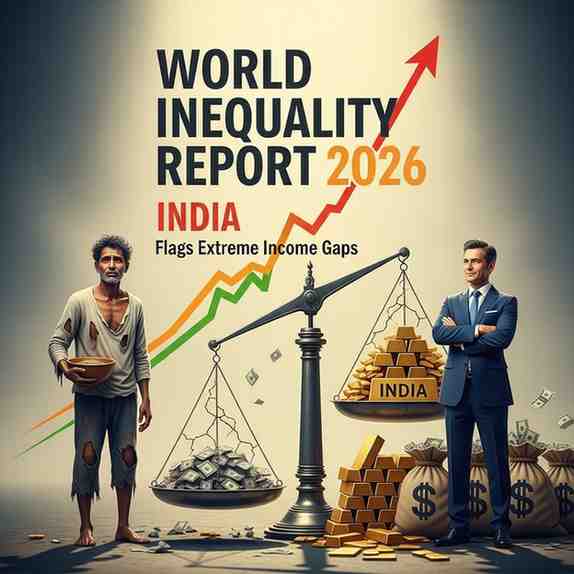
World Inequality Report 2026 Highlights Sharp Rise in Income and Wealth Gaps in India
The World Inequality Report 2026 places India among the most unequal large economies in the world, warning that income and wealth concentration has reached levels comparable to the colonial era . While India’s economy has expanded rapidly, the report finds that the benefits of growth have accrued overwhelmingly to the richest sections of society.
Income and Wealth Concentration
In 2025 , the top 10% of Indians earned 58% of national income , while the top 1% alone accounted for 22.6% , the highest share recorded since Independence. In contrast, the bottom 50% received only 15% of total income . Wealth inequality is even more pronounced: the richest 10% own 65% of household wealth , and the top 1% control over 40% . On several indicators, India ranks more unequal than countries such as Brazil and the United States .
Historical and Social Dimensions
The report notes that income distribution has reverted to patterns seen under British rule, undoing gains made in the decades following Independence. Gender inequality remains severe, with women accounting for only 18% of total labour income . Regional disparities persist, as rural bottom-50% incomes remain low while urban elites capture most gains. Scheduled Castes and Scheduled Tribes continue to be over-represented in lower income brackets, reflecting deep-rooted structural inequities.
Key Drivers of Inequality
Rising inequality is linked to technology-driven growth favouring skilled urban workers, concentration of corporate power, weak labour protections and a regressive tax structure . Stagnant real wages for the bottom 60% and a low tax-to-GDP ratio have limited redistribution.
Policy Path Ahead
The report recommends progressive wealth and inheritance taxes , higher taxation of top incomes and expansion of universal public services . Without corrective action, it warns, inequality could intensify further by 2030 , shaping India’s social and economic trajectory.
Exam Point
-
Top 10% earned 58% of income ; top 1% earned 22.6% (2025).
-
Top 10% own 65% of wealth ; top 1% control 40.1% .
-
Female labour-income share: 18% .
-
Recommendations include wealth tax, inheritance tax and universal basic services .
Month: Current Affairs - December 13, 2025
Category: Economic Inequality