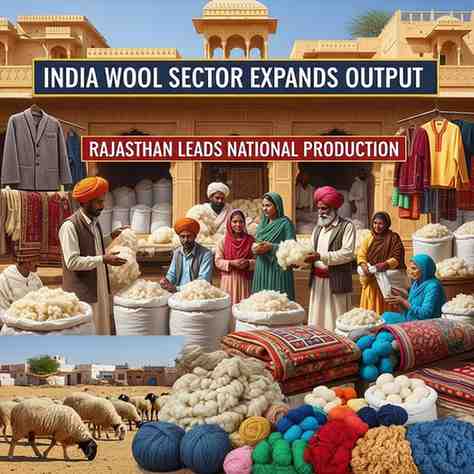
India’s Wool Industry: Scale and Significance
Wool remains a key natural fibre supporting India’s textile ecosystem, widely used in winter apparel, carpets, furnishings and several technical applications. With one of the largest sheep populations globally, India holds the ninth position in world wool output. The sector links pastoral communities, small producers and industrial processors, sustaining livelihoods across both rural and urban regions.
Production Levels and Leading States
In the financial year 2023–24, national wool production reached about 33.69 million kilograms. Rajasthan continued to dominate the landscape, contributing nearly half of the country’s output. Jammu & Kashmir emerged as the second-largest contributor, reflecting the importance of hill-based sheep rearing systems. Additional production hubs include Karnataka, Telangana, Gujarat, Maharashtra and Himachal Pradesh, illustrating that wool generation spans arid plains as well as temperate highland ecosystems.
Output Trends and Product Mix
Recent data indicates varied growth patterns across states, with Punjab recording the sharpest rise in annual production, followed by Tamil Nadu and Gujarat. India’s wool basket is heavily skewed toward carpet-grade fibre, which constitutes the majority share. Apparel-grade wool forms a much smaller proportion, while coarser varieties support industrial and utility uses. This distribution highlights India’s comparative advantage in carpet and rug manufacturing rather than fine clothing wool.
Organised and Decentralised Value Chain
The wool economy operates through a dual structure. The organised segment includes composite textile mills, combing and spinning units, carpet manufacturing clusters and garment factories. Alongside, a large decentralised network of handloom and powerloom units, knitting centres and dyeing workshops processes raw fibre into finished goods. This integrated chain connects shepherd households with domestic markets and export-oriented industries.
Livelihood Support and Animal Contribution
Employment generated by wool processing and allied activities remains substantial, supporting millions across shearing, grading, weaving and trading. Carpet weaving alone accounts for a sizeable share of jobs. From a livestock perspective, ewes contribute the largest portion of fleece output, followed by rams, wethers and lambs, demonstrating how flock composition directly influences productivity and income stability for pastoral families.
Exam-Focused Points
-
India ranks among the top ten global producers of wool.
-
Rajasthan contributes the highest share of national wool output.
-
Carpet-grade wool dominates India’s production profile.
-
The sector includes both organised textile mills and decentralised cottage industries.
-
Sheep rearing supports extensive rural employment across arid and hill regions.
Month: Current Affairs - February 09, 2026
Category: Agriculture & Animal Husbandry