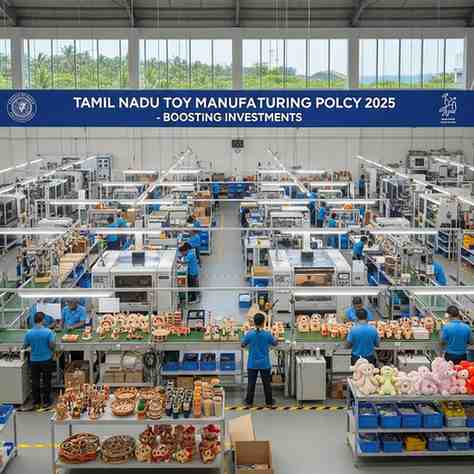
Tamil Nadu Launches Toy Manufacturing Policy 2025 to Position State as Emerging Industry Hub
Tamil Nadu has rolled out its Toy Manufacturing Policy 2025 , aiming to draw large-scale investment and expand India’s footprint in the fast-growing global toy sector. The policy, released at the Tamil Nadu Investors Conclave in Madurai, aligns with the State’s ambition to become a major production centre for advanced, electronic and electromechanical toys.
Policy Vision and Eligibility Framework
Toy manufacturing has been officially categorised as a sunrise sector under the Tamil Nadu Industrial Policy 2021. To qualify for the exclusive incentive package, companies must commit to investing at least ₹50 crore and generating a minimum of 50 jobs . These commitments must be fulfilled within three years, ensuring timely rollout of new projects and expansions.
District-Tiered Subsidy Model
Incentives are linked to the district category in which units are established.
-
A districts: 7% fixed capital subsidy for five years
-
B districts: 10% subsidy for ten years
-
C districts: 12% subsidy for ten years
Large investments of ₹300 crore or more in B and C districts also qualify for assistance under the structured package of TNIP 2021. Subsidies will be released annually once operations begin and investment commitments are verified.
Flexibility in Choosing Incentive Packages
Manufacturers may opt for either the Special Toy Manufacturing Incentive Package or the broader Sunrise Sector Incentive , depending on which offers greater strategic advantage. This flexibility allows firms to tailor benefits to their scale and location.
Exam Oriented Facts
-
Toy sector recognised as sunrise industry under TNIP 2021
-
Minimum eligibility: ₹50 crore investment + 50 jobs
-
Subsidy rates: 7% (A), 10% (B), 12% (C districts)
-
Design studios: 30% payroll subsidy for 12 months
Support for Design, Training and Traditional Toy Clusters
Additional measures include payroll support for design studios, enhanced skilling programmes, e-commerce onboarding for artisanal toy makers and financial aid—up to ₹3 lakh per category —for securing GI tags. These steps aim to strengthen both modern manufacturing and traditional craft-based toy clusters.
Month: Current Affairs - December 08, 2025
Category: State Industrial Policies