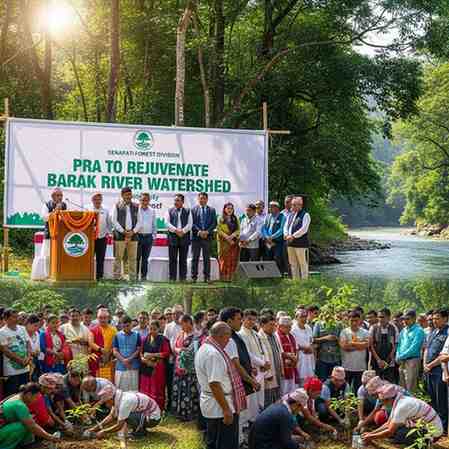
Community-Led PRA Initiative Aims to Restore Barak River Basin in Manipur
In a major step toward community-driven ecological restoration , the Senapati Forest Division has launched Participatory Rural Appraisal (PRA) exercises as a pilot initiative to rejuvenate the Barak River watershed . The programme seeks to blend scientific conservation planning with local knowledge, ensuring that ecosystem restoration goes hand in hand with livelihood security for forest-dependent communities.
Pilot PRA Exercise in Senapati District
The pilot PRA was conducted in Saranamai village of Senapati district, located within the Barak River catchment. The exercise involved close interaction with villagers to understand the social, economic, and ecological landscape of the area.
Using PRA tools such as resource mapping, land-use analysis, village timelines, wealth ranking, matrix ranking, and SWOT analysis , officials and community members jointly identified local priorities, environmental pressures, and development opportunities. This participatory process ensured that community voices were central to identifying both problems and solutions.
Integration with CAMPA Planning
Officials explained that the data collected through the PRA will serve as baseline inputs for preparing a detailed action plan under the Compensatory Afforestation Fund Management and Planning Authority (CAMPA) scheme of the Ministry of Environment, Forest and Climate Change.
The Senapati Forest Division plans to extend the PRA process to all villages across the Barak watershed , making forest and river basin management more inclusive, transparent, and locally relevant. This approach is expected to improve the effectiveness of afforestation, soil conservation, and watershed treatment measures.
Ecological Importance of the Barak River
The Barak River originates from Liyai Khullen village in Senapati district of Manipur and plays a vital ecological and socio-economic role in the region. Flowing through Manipur, it enters Assam’s plains before continuing into Bangladesh, where it becomes the Meghna River and drains into the Bay of Bengal.
The Barak basin is part of the larger Ganga–Brahmaputra river system and is the second-largest river basin in North-East India . Major tributaries such as the Makru, Irang, and Tuivai rivers support agriculture, fisheries, forests, and settlements across the region.
Addressing Environmental Stress Through Community Action
Despite its significance, the Barak watershed faces growing environmental stress due to deforestation, shifting cultivation, forest fires, floods, soil erosion, and landslides . Officials noted that these challenges cannot be addressed through top-down interventions alone.
The PRA-based approach enables integrated, multi-level solutions by combining technical expertise from forest departments with traditional ecological knowledge held by local communities. The initiative is expected to guide sustainable watershed rejuvenation, enhance forest cover, reduce land degradation, and improve income opportunities through eco-restoration activities.
Why This Initiative Matters
By placing communities at the centre of planning and implementation, the Senapati Forest Division’s initiative reflects a shift toward participatory conservation models . Such approaches not only strengthen environmental outcomes but also build long-term stewardship among local residents, making restoration efforts more resilient and sustainable.
Quick Facts for Exams
Month: Current Affairs - January 10, 2026
Category: ecological focus and regional significance