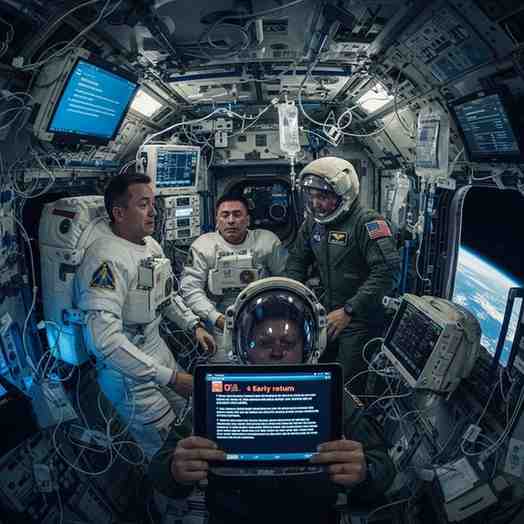
Crew-11 Astronauts to Return Early from ISS as NASA Prioritises Health and Safety
In a rare and historic move, the National Aeronautics and Space Administration (NASA) has announced the early return of four astronauts from the International Space Station (ISS) due to a medical concern affecting one crew member. The decision marks the first such early crew return in the ISS’s 25-year history of uninterrupted human presence , highlighting NASA’s unwavering emphasis on astronaut health and safety.
Early Conclusion of the Crew-11 Mission
The Crew-11 mission , launched to the ISS in August last year aboard a SpaceX Crew Dragon , was originally planned as a standard six-month stay. NASA has now opted to bring the entire crew back to Earth nearly a month ahead of schedule .
Officials clarified that the situation does not constitute an emergency evacuation . The astronaut experiencing the medical issue is reported to be stable, and the early return is a precautionary step to ensure optimal medical care on Earth rather than in orbit.
Crew Composition and Continuity on the ISS
Crew-11 consists of:
-
Zena Cardman (NASA)
-
Mike Fincke (NASA)
-
Kimiya Yui (JAXA, Japan)
-
Oleg Platonov (Russia)
After their return, the ISS will continue operating with one American astronaut and two Russian cosmonauts onboard. This ensures the station maintains the minimum required crew to oversee safety, manage life-support systems, and conduct essential maintenance.
Medical Protocols and Precautionary Measures
NASA’s decision followed the sudden cancellation of a scheduled spacewalk earlier in the week, prompted by the same medical concern. Although the issue was not related to an injury or spacecraft malfunction, officials stressed that spacewalks demand peak physical fitness and carry high physiological risks.
Medical care on the ISS relies heavily on onboard diagnostic equipment and real-time telemedicine , with Earth-based doctors guiding astronauts through secure communication links. When recovery is assessed to be safer on Earth, early return becomes the preferred medical protocol .
Impact on Research and Mission Planning
The reduced crew presence may temporarily delay some scientific experiments and maintenance tasks . Remaining astronauts will prioritise critical station operations over research activities until the next crew rotation.
NASA officials reiterated that flexibility is a cornerstone of human spaceflight. Mission timelines can change, experiments can wait—but astronaut health cannot be compromised.
Why This Decision Matters
This unprecedented step underscores a core principle of space exploration: human safety overrides all mission objectives . The early return sets an important operational precedent and reflects the maturity of modern spaceflight systems, which allow agencies to adapt quickly to medical or operational concerns.
Quick Facts for Exams
Month: Current Affairs - January 10, 2026
Category: NASA’s safety-first approach