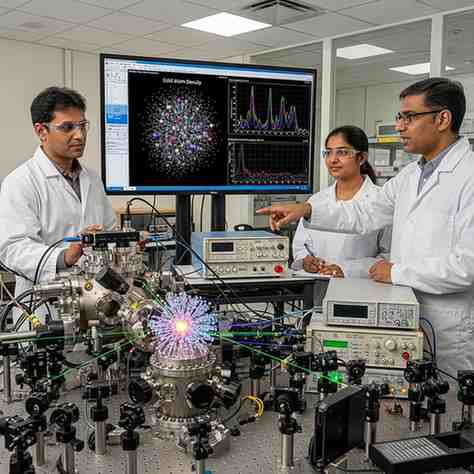
India Advances Quantum Technology with RRI’s Raman Driven Spin Noise Spectroscopy Breakthrough
Scientists at the Raman Research Institute (RRI), Bengaluru, have achieved a major breakthrough in experimental quantum physics by developing a non-invasive, real-time method to measure the local density of cold atoms without significantly disturbing their fragile quantum state. This advancement is expected to play a crucial role in strengthening India’s capabilities in quantum computing, quantum sensing, and ultra-precise measurement technologies.
Why Measuring Cold Atoms Is So Difficult
Cold atoms—cooled to temperatures extremely close to absolute zero using advanced laser techniques—exhibit pronounced quantum behaviour. These systems form the backbone of modern quantum devices such as atomic clocks, quantum simulators, and sensors. However, observing them accurately has always posed a challenge.
Traditional techniques like absorption imaging and fluorescence imaging come with serious limitations. Absorption imaging struggles when atomic clouds become dense, while fluorescence imaging often requires long exposure times that can heat, disturb, or even destroy the atomic system. As a result, scientists have long sought a method that could “look” at atoms without interfering with their quantum nature.
Raman Driven Spin Noise Spectroscopy: A Game Changer
To address this challenge, RRI researchers developed a novel technique known as Raman Driven Spin Noise Spectroscopy (RDSNS) . The approach builds upon spin noise spectroscopy, a method that passively detects natural fluctuations in atomic spins by observing tiny changes in the polarisation of a probe laser beam.
What makes RDSNS unique is the addition of two Raman laser beams that coherently drive atoms between neighbouring spin states. This dramatically amplifies the otherwise weak spin noise signal—by nearly a million times—without forcing the atoms out of their quantum state. The result is an exceptionally sensitive probe capable of measuring an ultra-small volume of about 0.01 cubic millimetres , corresponding to regions as tiny as 38 micrometres and containing roughly 10,000 atoms .
Experimental Proof and Key Observations
The team validated the technique using potassium atoms confined in a magneto-optical trap. With RDSNS, they observed that the central density of the atomic cloud stabilised within one second , whereas conventional fluorescence imaging showed that the total atom number took almost twice as long to settle.
This difference highlights a major advantage of the new method: RDSNS measures local atomic density , not just global atom counts. The researchers further confirmed the accuracy of the technique by comparing its results with fluorescence images analysed using the inverse Abel transform. The close agreement between the two methods demonstrated that RDSNS delivers reliable density measurements without relying on simplifying assumptions about symmetry.
Why This Breakthrough Matters
Non-invasive, real-time measurements are essential for the next generation of quantum technologies. Devices such as quantum gravimeters, magnetometers, and quantum simulators demand precise control and continuous monitoring of atomic systems without disrupting them.
According to Saptarishi Chaudhuri , who heads the QuMIX laboratory at RRI, the ability to probe matter at micron scales without disturbing quantum coherence opens up exciting possibilities. Researchers can now study quantum transport, non-equilibrium dynamics, and local density fluctuations with unprecedented clarity.
A Boost for India’s Quantum Mission
The research has been supported under India’s National Quantum Mission , underscoring the country’s push to become a global leader
Month: Current Affairs - January 09, 2026
Category: Precision Quantum Measurement Research