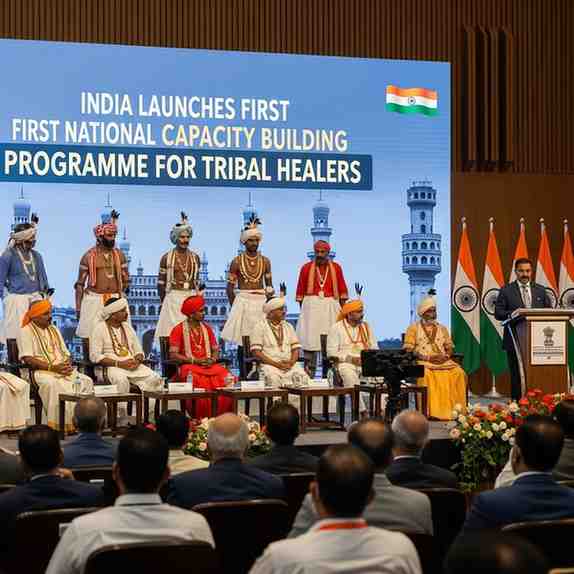
India’s First National Programme for Tribal Healers to Strengthen Health Outreach in Tribal Areas
In a landmark move towards inclusive and culturally grounded development, the Ministry of Tribal Affairs is set to organise India’s first National Capacity Building Programme for Tribal Healers on Strengthening Health Outreach in Tribal Areas on January 16–17, 2026 , in Hyderabad, Telangana . The initiative represents a paradigm shift in India’s public health strategy by formally recognising tribal and indigenous healers as vital grassroots partners in healthcare delivery.
The programme aims to bridge traditional knowledge systems with evidence-based public health practices, ensuring improved health access in tribal and Particularly Vulnerable Tribal Group (PVTG) regions.
High-Level Participation Reflects Policy Commitment
The two-day programme will witness the participation of Union Minister for Tribal Affairs Jual Oram , Minister of State Durgadas Uikey , and Secretary, Ministry of Tribal Affairs Ranjana Chopra . Their presence underscores the Government of India’s sustained commitment to culturally sensitive, community-driven health interventions in tribal regions.
MoU for Bharat Tribal Health Observatory Under Project DRISTI
A major outcome of the programme will be the signing of a Memorandum of Understanding between the Ministry of Tribal Affairs and ICMR–Regional Medical Research Centre Bhubaneswar for the establishment of India’s first National Tribal Health Observatory , named the Bharat Tribal Health Observatory .
The Observatory will function under Project DRISTI , institutionalising tribe-disaggregated health surveillance , implementation research, and data-driven disease elimination strategies. This initiative seeks to address long-standing gaps in tribal health data, enabling more targeted and evidence-based policymaking.
Strengthening Tribal Health Ecosystem
Over the years, the Ministry of Tribal Affairs has emerged as a key nodal agency for addressing health inequities in tribal areas. It has led focused interventions such as the National Sickle Cell Anaemia Elimination Mission and strengthened convergence with national programmes targeting tuberculosis, leprosy, and malaria.
Flagship initiatives like PM JANMAN and DAJGUA have further enhanced health infrastructure, outreach, and service delivery in remote tribal regions, positioning the Ministry at the forefront of inclusive public health governance.
Integrating Indigenous Knowledge with Modern Public Health
The programme is being organised with technical collaboration from institutions such as the Indian Council of Medical Research , All India Institute of Medical Sciences New Delhi , the Ministry of Health and Family Welfare, the Ministry of AYUSH, and the World Health Organization .
Key components include structured training of tribal healers, ethical safeguards, digital health documentation, referral mechanisms, and disease surveillance. The initiative reinforces a synergistic approach where indigenous knowledge systems complement modern medical frameworks to improve last-mile health outcomes.
Exam-Focused Points
-
First national-level capacity building programme for tribal and indigenous healers in India.
-
Bharat Tribal Health Observatory will enable tribe-wise disaggregated health data .
-
Initiative implemented under Project DRISTI of the Ministry of Tribal Affairs.
-
Focus on sickle cell anaemia, TB, malaria, and other vector-borne diseases.
-
Promotes convergence between traditional healing systems and modern public health.
-
Supports evidence-based policymaking for PVTG and tribal regions.
Month: Current Affairs - Jan 16, 2026
Category: Tribal Affairs | Health Governance