Amit Shah Chairs 9th NCORD Apex Meeting, Unveils Roadmap for Drug-Free India
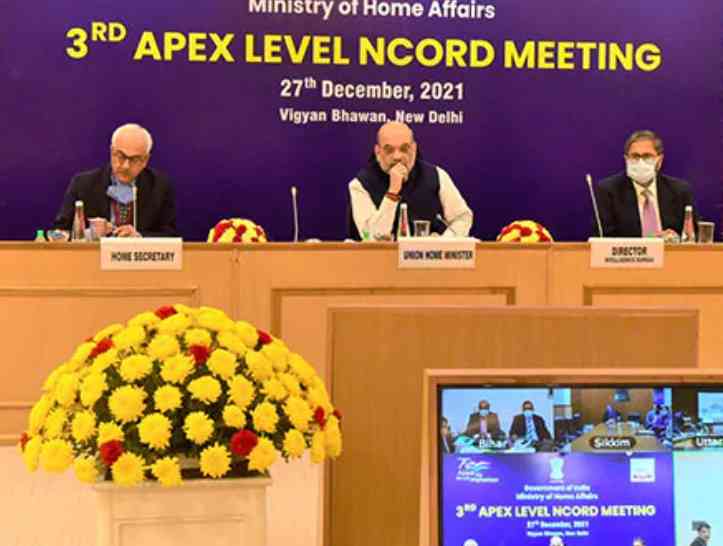
Union Home Minister and Minister of Cooperation Amit Shah chaired the 9th Apex-Level Meeting of the Narco-Coordination Centre (NCORD) at Vigyan Bhawan, New Delhi, reaffirming the Government of India’s resolve to eradicate the drug menace. On the same occasion, he inaugurated the Narcotics Control Bureau (NCB) office at Amritsar.
The meeting, organised in a hybrid format by the NCB, witnessed participation from central ministries, state governments, and multiple drug law enforcement agencies.
Vision for a Drug-Free India by 2029
Addressing the gathering, the Home Minister called upon all concerned departments to prepare a comprehensive anti-drug roadmap extending up to 2029 , supported by clearly defined milestones and a robust review mechanism. He underlined that drug trafficking should be viewed not merely as a law-and-order challenge but as a form of narco-terrorism aimed at weakening India’s youth and national security.
Shri Shah announced that from March 31, 2026 , a three-year nationwide collective campaign would be launched, with clearly defined targets, operational strategies, and accountability frameworks.
Three-Pillar Strategy Against the Drug Menace
The Home Minister outlined a three-pronged national strategy to eliminate drugs:
-
Ruthless action against supply chains , including manufacturers, traffickers, and financiers.
-
Strategic demand reduction , focusing on awareness, prevention, and community engagement.
-
Humane harm reduction , emphasising treatment, rehabilitation, and social reintegration of drug users.
He stressed zero tolerance for those involved in drug production and trafficking, while advocating compassion and rehabilitation for victims of addiction. Strengthening command structures, compliance, and accountability was identified as essential for sustained success.
Enforcement Achievements and Operational Gains
Highlighting enforcement outcomes, Shri Shah noted a sharp escalation in drug seizures and destruction over the past decade. While drugs worth around ?40,000 crore were seized between 2004 and 2013, seizures increased to approximately ?1.71 lakh crore during 2014–2025 .
The quantity of narcotics destroyed has risen eleven-fold , and enforcement agencies have intensified action against synthetic drugs . He also cited the expansion of illicit opium crop destruction, from 10,770 acres in 2020 to nearly 40,000 acres by November 2025 , reflecting stronger ground-level action.
Strengthening the Institutional Framework
The NCORD mechanism operates through a four-tier structure —apex, executive, state, and district levels—ensuring seamless coordination across agencies. The Home Minister directed states and central departments to accelerate drug disposal processes, enhance forensic support, and improve conviction rates.
He emphasised that protecting India’s youth from drugs is central to achieving the country’s long-term goal of becoming a global leader by 2047 .
Key Exam-Focused Points
-
NCORD was established in 2016 to strengthen inter-agency coordination against drug trafficking.
Month: Current Affairs - January 12, 2026
Category: Governance, Internal Security