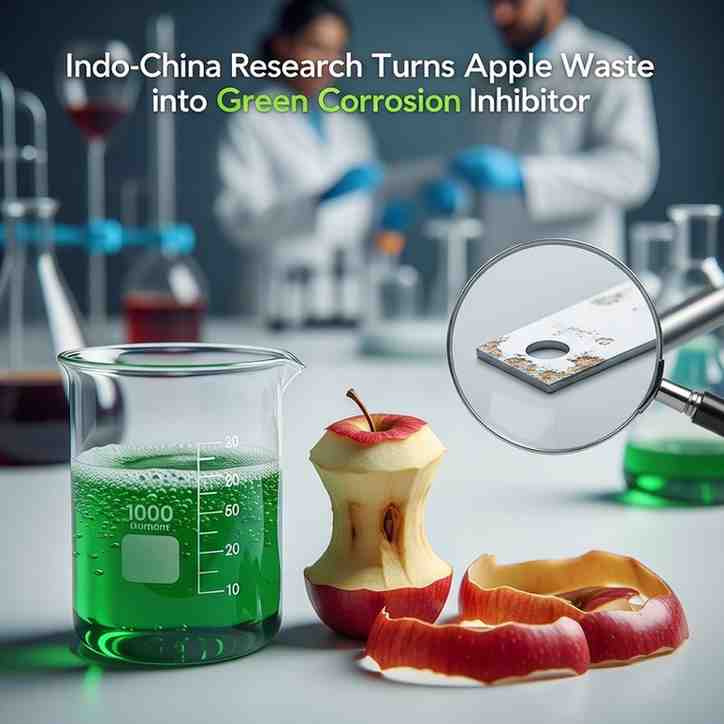
Indo-China Study Finds Green Corrosion Shield from Waste Apple Leaves
A joint research initiative between Indian and Chinese universities has revealed a sustainable, bio-based technique to protect metals from corrosion using discarded apple leaves . The innovation presents an environmentally safe alternative to toxic industrial corrosion inhibitors and underlines the expanding relevance of green chemistry in infrastructure, energy, and manufacturing sectors.
Cross-Border Academic Collaboration
The study was carried out by researchers from Nagaland University and University of Science and Technology Beijing . Led by Prof. Ambrish Singh and Prof. Yujie Qiang, the collaboration demonstrates how international academic partnerships can transform agricultural waste into high-value industrial solutions while addressing global sustainability challenges.
Apple-Leaf Carbon Quantum Dots: How They Work
Scientists converted waste apple leaves into carbon quantum dots (CQDs) using a green hydrothermal synthesis method. These CQDs, doped with nitrogen and sulfur, possess multiple chemically active sites that adhere strongly to metal surfaces.
Experimental results showed that the apple-leaf CQDs achieved 94%–96.2% corrosion inhibition efficiency for copper in acidic environments. The protection remained effective even at low inhibitor concentrations and during prolonged exposure, highlighting their robustness and practical potential.
Industrial Relevance and Environmental Benefits
Corrosion causes massive economic losses in industries such as oil and gas, power generation, chemical manufacturing, and wastewater treatment. The study found that the bio-derived inhibitors form a dense, stable protective film on copper surfaces, preventing corrosive ions from interacting with the metal.
By replacing conventional toxic inhibitors, this method can:
-
Extend the lifespan of pipelines and industrial equipment
-
Reduce environmental pollution and occupational health risks
-
Support cleaner and safer industrial operations
Waste-to-Wealth and Circular Economy Potential
The research also points to the economic value of agricultural waste , opening possibilities for farmer-linked supply chains that convert biomass residues into advanced nanomaterials. Such innovations strengthen circular economy models by combining waste reduction with industrial utility.
The findings were published in Journal of Alloys and Compounds . While the current work is laboratory-based, researchers are preparing for pilot-scale trials and real-world industrial testing.
Exam-Focused Points
-
Carbon quantum dots are nanoscale carbon materials with functional surface groups.
-
Corrosion inhibitors slow metal degradation in acidic or harsh conditions.
-
Waste-to-wealth approaches support circular economy and sustainability goals.
-
Green chemistry aims to minimise toxic substances in industrial processes.
-
Agricultural waste can be converted into high-value nanomaterials.
Month: Current Affairs - January 20, 2026
Category: Science & Technology | Environment