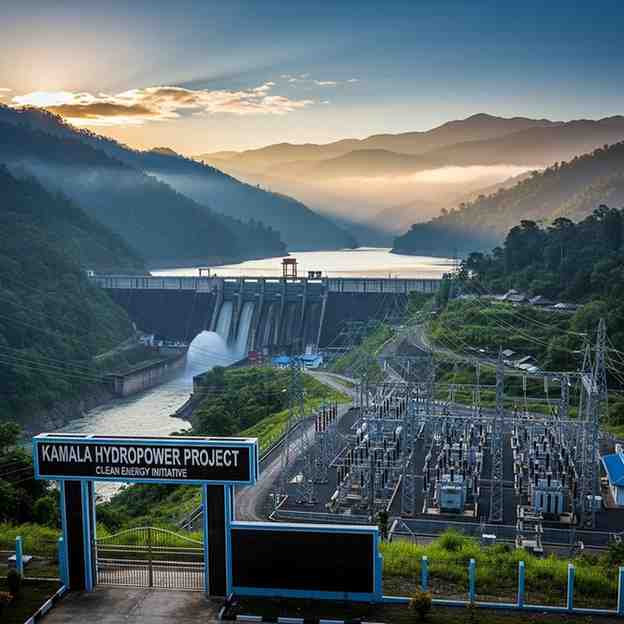
₹26,070-Crore Kamala Hydroelectric Project Approved to Boost India’s Renewable Energy Goals
India has taken a major step toward accelerating its renewable energy transition with the approval of the ₹26,070-crore Kamala Hydroelectric Project by the Public Investment Board (PIB) . Located in Arunachal Pradesh, the project aligns with India’s long-term clean energy goals and its commitment to achieving net-zero emissions by 2070 .
Project Overview and Strategic Location
The Kamala Hydroelectric Project—earlier referred to as the Subansiri Middle Hydroelectric Project —is a storage-based hydropower scheme with an integrated flood moderation component. It is proposed on the Kamala River and spans the districts of Kamle, Kra Daadi, and Kurung Kumey in Arunachal Pradesh.
With an installed capacity of 1,720 MW , the project is expected to generate approximately 6,870 million units (MU) of electricity annually , significantly strengthening both the regional and national power grids. Its strategic location in the Northeast makes it a key contributor to balanced regional energy development.
Engineering Design and Construction Features
The project involves the construction of a 216-metre-high concrete gravity dam along with an underground powerhouse . The scheduled construction period is 96 months from the commencement of works.
Beyond power generation, the project’s reservoir will help regulate river flows, offering flood moderation benefits to downstream regions—particularly the Brahmaputra Valley , which is prone to recurrent monsoon flooding. This dual-purpose design enhances the project’s overall socio-environmental value.
Investment Structure and Financial Framework
The Kamala project will be implemented under a Build–Own–Operate–Transfer (BOOT) model through a joint venture. NHPC will hold a 74% equity stake , while the Government of Arunachal Pradesh will own the remaining 26% .
The estimated project cost stands at ₹26,069.5 crore , financed through a 70:30 debt–equity ratio . Central government support includes:
-
₹1,340 crore for enabling infrastructure
-
₹4,744 crore for the flood moderation component
Additionally, the state government will reimburse the full State GST . The project’s levelised tariff is estimated at ₹5.97 per unit , making it competitive among large hydropower projects.
Employment Generation and Regional Development
During peak construction, the project is expected to create around 300 direct jobs and nearly 2,500 contractual jobs . Over the long term, it is likely to stimulate infrastructure development in remote areas, improve connectivity, and enhance grid stability across the Northeast.
The project is also expected to play a role in strengthening India’s renewable energy mix by providing reliable baseload power, complementing intermittent sources like solar and wind.
Why the Kamala Project Matters
Large hydropower projects like Kamala are critical for India’s clean energy transition. By combining electricity generation with flood control, the project addresses both energy security and climate resilience . It also reinforces the strategic importance of the Northeast as a hub
Month: Current Affairs - January 10, 2026
Category: project approval