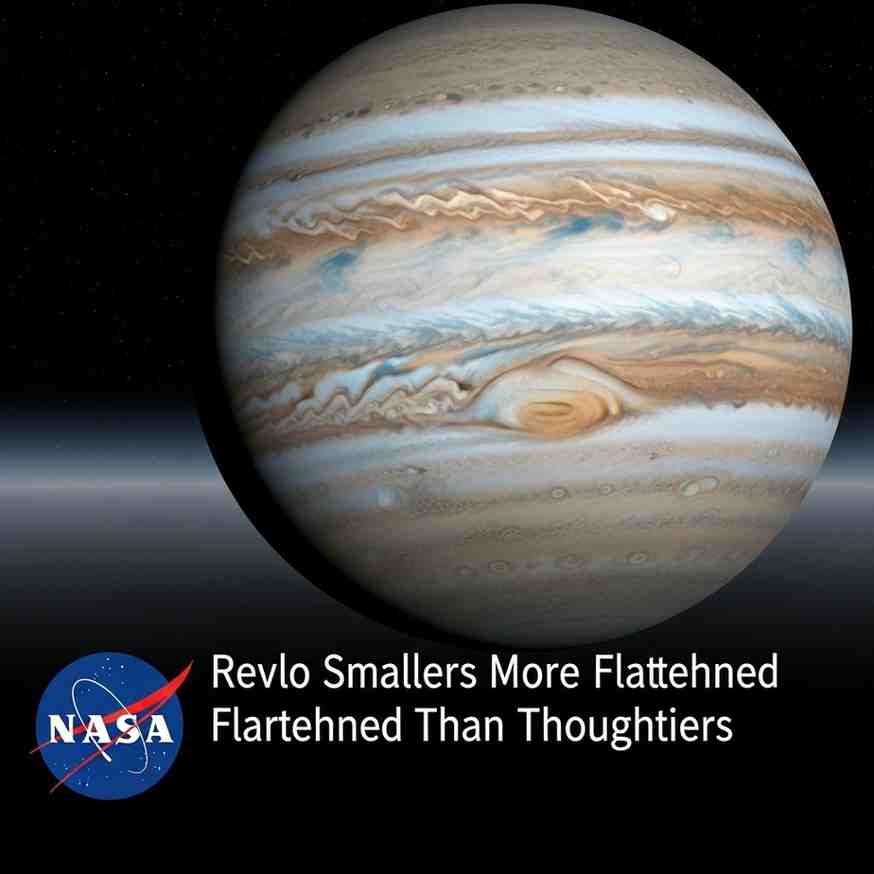
Jupiter’s Size and Shape Reassessed
Jupiter , the largest planet in the solar system, is slightly smaller and more oblate than earlier estimates suggested, according to new findings derived from data collected by Juno . The revised measurements represent the most accurate assessment to date of the gas giant’s dimensions and offer valuable clues about its internal composition and formation history.
More Precise Measurements Using Juno Data
By analysing high-precision radio science observations from the Juno spacecraft, scientists calculated Jupiter’s equatorial diameter at 88,841 miles (142,976 km) . This is about 5 miles smaller than values estimated from Voyager and Pioneer missions conducted in the late 1970s.
Jupiter’s polar diameter was measured at 83,067 miles (133,684 km) —approximately 15 miles smaller than earlier calculations. Although the differences appear minor, they are significant at planetary scales and improve the accuracy of physical models of the planet.
Jupiter Is More Flattened Than Earlier Believed
The updated analysis confirms that Jupiter is more flattened at the poles than previously understood. The planet is about 7% wider at the equator than from pole to pole , a consequence of its extremely rapid rotation and fluid composition dominated by hydrogen and helium.
For comparison, Earth shows only about 0.33% equatorial bulging , highlighting how rotation affects gas giants far more strongly than rocky planets. This enhanced oblateness offers fresh insight into how mass is distributed inside Jupiter .
How Juno Enabled High-Accuracy Results
The precise measurements were made when Juno passed behind Jupiter relative to Earth , allowing its radio signals to traverse the planet’s atmosphere. Subtle changes in the signal revealed variations in atmospheric density and temperature .
According to planetary scientist Eli Galanti of the Weizmann Institute of Science , these signal distortions enabled scientists to calculate Jupiter’s size and shape with exceptional accuracy. The observations were carried out after NASA extended the Juno mission in 2021 , allowing deeper investigation of the planet’s structure.
Why Jupiter’s Size Matters for Planetary Science
Accurate measurements of Jupiter’s radius are critical for refining models of its interior, atmosphere, and gravitational field . As the most massive planet in the solar system, Jupiter is believed to have formed early and played a central role in shaping planetary architecture.
Scientists think Jupiter influenced the distribution of material , migration of smaller bodies, and delivery of volatile compounds such as water and ammonia to the inner solar system, including Earth. Improved size and shape data therefore enhance understanding of both Jupiter’s evolution and the solar system’s origin .
Exam-Focused Key Points
-
Jupiter is the fifth planet from the Sun and the largest in the solar system
-
Juno mission has been orbiting Jupiter since 2016
-
New data shows Jupiter is smaller
Month: Current Affairs - February 05, 2026
Category: Science & Technology | Space Missions