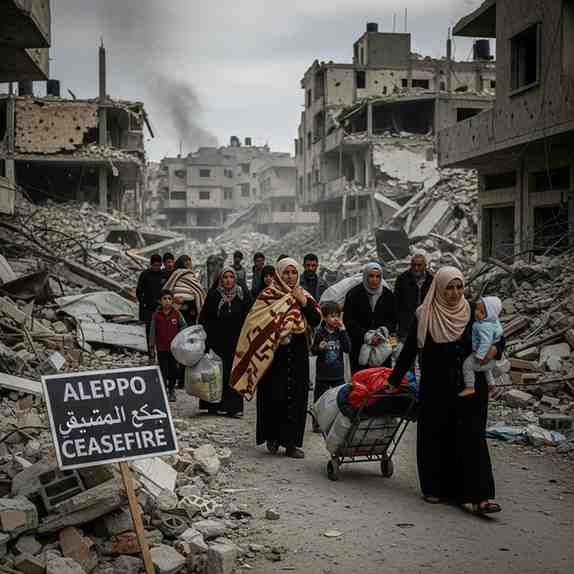
Ceasefire in Aleppo After Days of Heavy Fighting
The Syrian government has announced a ceasefire in Aleppo following three days of intense clashes with Kurdish forces that forced more than 140,000 civilians to flee their homes. The violence marked the most serious escalation in over six months and exposed the continuing fault lines between Damascus and Kurdish authorities over control, governance, and Syria’s political future.
The ceasefire came into effect at 3 am local time, bringing a temporary halt to fighting in several contested neighbourhoods. Under the government’s announcement, Kurdish fighters were expected to withdraw from Sheikh Maqsoud, Ashrafieh, and Bani Zaid, with safe passage offered toward north-eastern Syria, an area under Kurdish influence. However, the durability of the truce remains uncertain, as Kurdish leadership has not formally confirmed acceptance of these terms.
Conflicting Narratives on the Ground
Residents reported a noticeable reduction in gunfire overnight, but both sides issued contradictory statements. Kurdish internal security forces denied requesting safe passage and instead demanded the withdrawal of Syrian government troops from Kurdish-majority areas. Syrian forces, meanwhile, released footage claiming to show underground tunnels allegedly used by Kurdish fighters to transport weapons and personnel beneath the city.
International Responses and Mediation Efforts
The ceasefire was welcomed by the United States, which described it as a positive step toward de-escalation. Washington has long supported Kurdish forces for their role in defeating the Islamic State and has encouraged their integration into Syria’s national framework. Turkey, however, reiterated support for Damascus and criticised Kurdish control over territory, citing security concerns.
Broader Implications for Syria
Aleppo’s Kurdish neighbourhoods symbolise the unresolved debate between decentralisation and central authority. While Damascus insists on full state control, Kurdish groups seek autonomy guarantees. The latest clashes underline how fragile ceasefires remain in Syria’s unresolved post-war landscape.
Key Facts for Exams
-
Aleppo is a recurring flashpoint between Syrian forces and Kurdish groups
-
Kurdish forces control roughly one-third of Syrian territory
-
The US backs Kurdish forces mainly for anti–Islamic State operations
-
Turkey views Kurdish armed groups as linked to the PKK
Month: Current Affairs - January 10, 2026
Category: Conflict Resolution & Security Dynamics