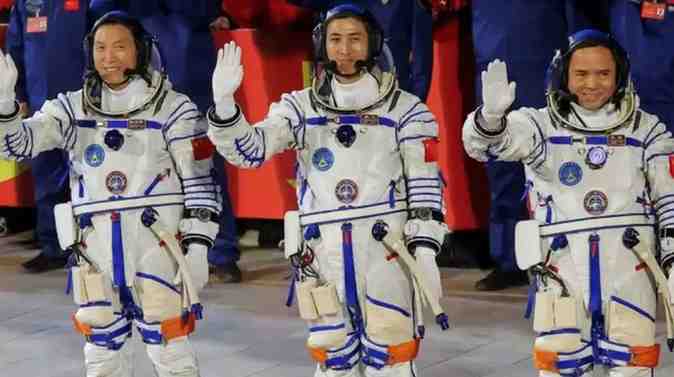
- China has successfully launched the Shenzhou-21 mission to its Tiangong Space Station , marking another major milestone in the country’s expanding space programme. The mission, which lifted off on October 31, 2025 , carries a three-member crew and, for the first time, laboratory mice to conduct biological experiments in space.
Launch Details and Crew
- The Long March-2F rocket carrying Shenzhou-21 lifted off at 11:44 pm local time (1544 GMT) from the Jiuquan Satellite Launch Centre in northwest China’s Gobi Desert. The spacecraft is set to dock with Tiangong within three and a half hours of launch. The crew includes mission commander Zhang Lu , flight engineer Wu Fei , and payload specialist Zhang Hongzhang . Notably, Wu Fei , aged 32 , has become China’s youngest astronaut to enter orbit, symbolizing the new generation of Chinese space explorers.
Biological and Scientific Objectives
- In a historic first for China’s human spaceflight programme, Shenzhou-21 carries four laboratory mice — two males and two females — to study the effects of microgravity on mammalian physiology and reproduction . These experiments aim to enhance understanding of how long-term space conditions affect living organisms, an essential step in preparing for deep-space and lunar missions . The astronauts will also conduct spacewalks, install anti-debris shields , and perform educational outreach sessions with students on Earth.
Strategic Importance and Future Goals
- The Shenzhou-21 mission aligns with President Xi Jinping’s “space dream” , which envisions China as a global leader in space exploration. Building on earlier achievements such as the Chang’e-4 Moon landing (2019) and Mars rover mission (2021) , China now aims to send astronauts to the Moon by 2030 . The Tiangong Space Station , completed in 2022, serves as a permanent orbital platform for scientific research, astronaut training, and international cooperation.
Global Context and Significance
- Since its exclusion from the International Space Station (ISS) in 2011, China has pursued an independent path in human spaceflight, developing its own infrastructure and expanding collaborations with nations such as Pakistan . The Shenzhou-21 mission reinforces China’s growing technological capabilities and commitment to advancing space science and biological research.
Exam-Oriented Facts:
-
Launched: October 31, 2025 from Jiuquan Launch Centre .
-
Wu Fei (32) – youngest Chinese astronaut in space.
-
Includes China’s first in-orbit rodent experiments .
-
Supports China’s 2030 crewed Moon mission goal .
-
Part of China’s independent Tiangong Space Station programme .
Month: Current Affairs - November 01, 2025
Category: Science and Technology