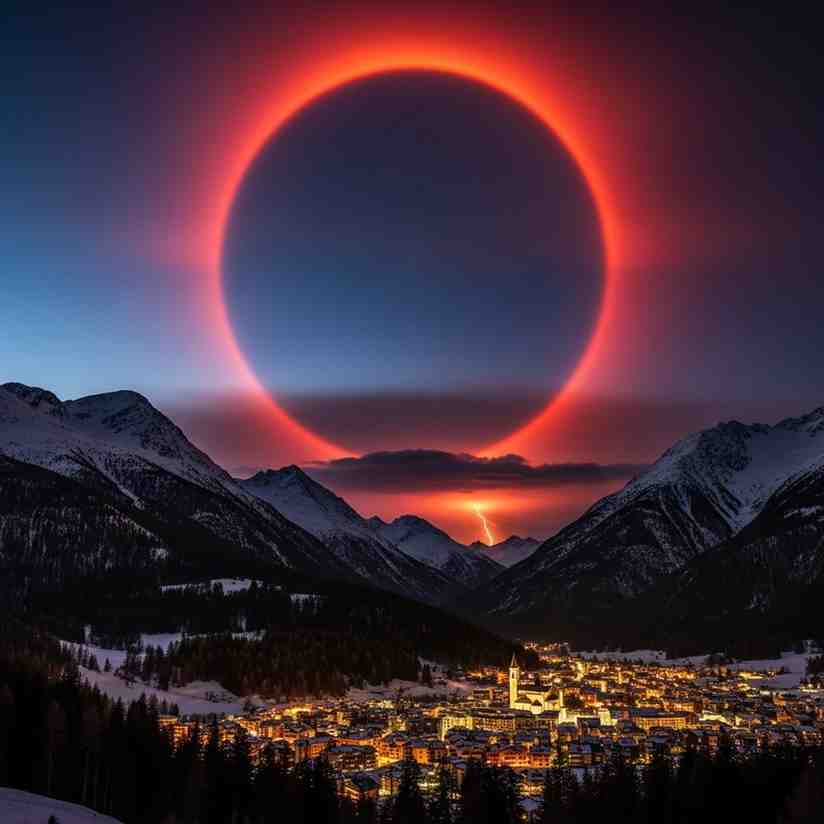
Rare Red ELVE Halo Reappears Over Italian Alpine Town
A spectacular red halo illuminated the skies over Possagno , a small town in northern Italy, on November 17 , marking the second occurrence of this unusual atmospheric display in just three years. The phenomenon, photographed by Valter Binotto, formed a near-perfect luminous ring approximately 200 km wide at an altitude close to 100 km . Its reappearance over the same location has drawn significant scientific curiosity due to the rarity and extremely brief duration of such upper-atmospheric events.
What Are ELVEs?
The observed halo is classified as an ELVE , a rapid and expanding disk of light produced in the lower ionosphere. These events occur when a powerful lightning strike emits an intense electromagnetic pulse (EMP) , which energises atmospheric molecules. ELVEs last only a millisecond, making them exceedingly difficult to observe without high-speed cameras. In this case, the lightning bolt responsible carried a massive 303 kilo-ampere current—several times stronger than typical lightning.
NASA’s TLE Classification
ELVEs are part of the larger family of Transient Luminous Events (TLEs) —a group of fleeting electrical emissions that appear above thunderstorms. First documented by NASA in the early 1990s, TLEs include sprites, halos and blue jets, each with distinct shapes and colours based on the layers of the atmosphere they form in and the characteristics of the triggering lightning.
Why ELVEs Look Red on Earth
The red glow of ELVEs results from the excitation of nitrogen molecules in Earth's upper atmosphere. On planets with different atmospheric compositions, ELVEs take on different colours; observations from NASA’s Juno mission, for instance, revealed pink and blue TLEs in Jupiter’s hydrogen-rich skies.
Exam Oriented Facts
-
ELVEs are expanding rings of light triggered by lightning-generated EMPs .
-
The halo observed over Possagno measured ~200 km across at ~100 km altitude .
-
TLEs were first identified by NASA in the 1990s .
-
ELVEs appear red on Earth due to nitrogen interactions in the upper atmosphere.
Month: Current Affairs - December 03, 2025
Category: atmospheric science, lightning phenomena