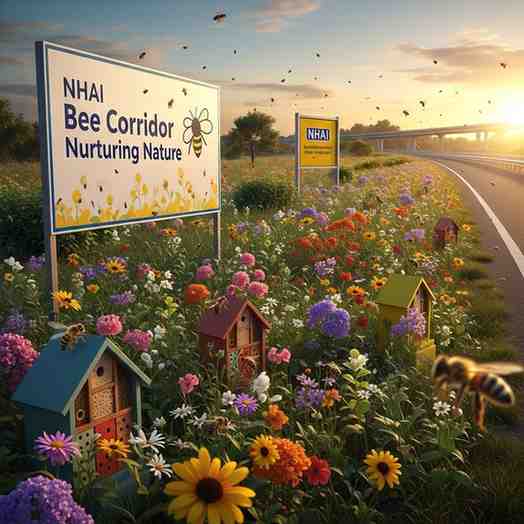
Pollinator-Friendly Highways Mark Shift in Sustainable Infrastructure
Reinforcing its emphasis on environmentally responsible infrastructure, the National Highways Authority of India (NHAI) has introduced a pioneering initiative to develop pollinator-friendly green corridors, widely termed ‘Bee Corridors’, along National Highways. The programme marks a shift from ornamental roadside plantations towards ecologically functional landscapes designed to support honeybees and other pollinators.
Ecological Rationale and Importance
The Bee Corridors will consist of continuous stretches of nectar- and pollen-rich vegetation. By selecting species with staggered flowering cycles, NHAI aims to maintain blooming across seasons, ensuring a stable food source for pollinators.
Pollinators are fundamental to ecosystem health and agricultural productivity. Scientific estimates indicate that nearly one-third of global food crops depend on animal-mediated pollination. The decline of bee populations worldwide has therefore triggered concerns about food security and biodiversity stability. Highways, given their linear and extensive nature, present a valuable opportunity to establish long, connected ecological habitats.
Plant Species and Design Strategy
NHAI plans to prioritise native, nectar-rich species including Neem, Karanj, Mahua, Palash, Bottle Brush, Jamun and Siris. The vegetation mix will incorporate trees, shrubs, grasses and herbs. Importantly, flowering weeds will be permitted to bloom, while dead wood and hollow trunks will be preserved to create nesting habitats for wild pollinators.
Suitable National Highway stretches and vacant land parcels will be identified by field offices, factoring in regional agro-climatic conditions. Flowering clusters will be established at intervals of 500 metres to 1 kilometre, corresponding to typical pollinator foraging ranges.
Targets for 2026–27
For the financial year 2026–27, NHAI aims to plant approximately 40 lakh trees along National Highways, with nearly 60 per cent designated under the Bee Corridor initiative. Field offices have been directed to develop at least three dedicated pollinator corridors within the year.
Important Facts for Exams
-
Pollinators enable reproduction of over 75% of flowering plants globally.
-
Honeybees generally forage within about 1 kilometre from hives.
-
Neem and Palash are ecologically significant native species.
-
Ecological corridors reduce habitat fragmentation and enhance biodiversity.
Sustainable Infrastructure Perspective
The Bee Corridor initiative reflects a broader transition towards biodiversity-integrated infrastructure planning. By combining highway development with pollinator conservation, NHAI seeks to enhance green cover, strengthen ecosystem services and promote climate-resilient landscapes. The programme exemplifies how transport infrastructure can be aligned with ecological sustainability objectives.
Month: Current Affairs - February 18, 2026
Category: Environment | Biodiversity