Budget 2026 Revamps Rural Employment with New Scheme and Altered Funding
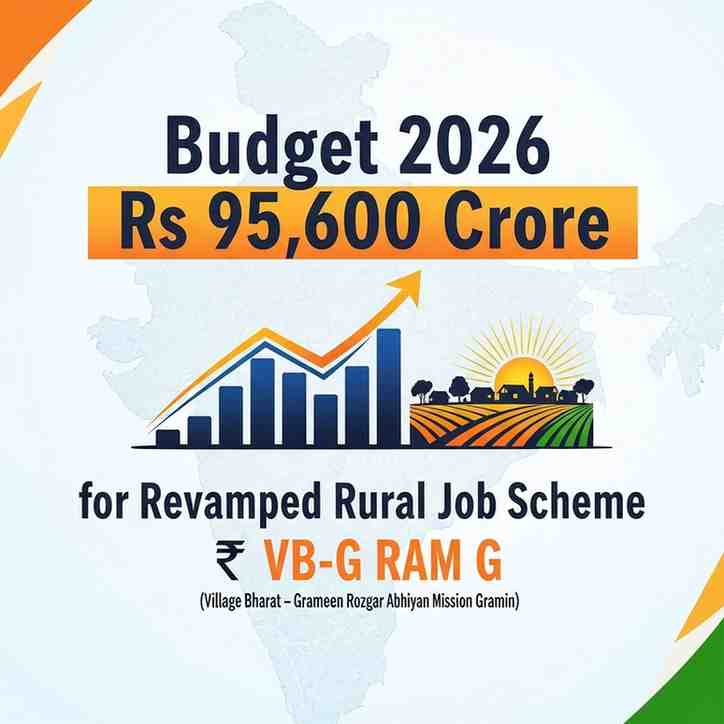
The Union Budget 2026-27 has earmarked Rs 95,600 crore for the newly restructured Viksit Bharat-G RAM G (VB-G RAM G) rural employment initiative, highlighting a reinforced focus on job creation amidst persistent agrarian sector stress. This allocation marks an increase of nearly Rs 10,000 crore from the Rs 86,000 crore provided for MGNREGA in the previous fiscal year, but accompanies a major shift in financial responsibilities between the centre and states.
Enhanced Outlay for Rural Employment Support
The increased budgetary provision signals the central government's commitment to sustaining rural employment, where demand for wage work remains high. The redesigned VB-G RAM G framework is positioned as a more efficient and outcome-focused successor to MGNREGA, emphasizing durable asset creation and better convergence with other rural development programs. The higher outlay aims to ensure employment continuity while transforming the scheme's operational model.
Revised Funding Formula Alters Federal Dynamics
A key change under the new framework is the revised cost-sharing formula . The central government will now fund 60% of the total scheme cost , with state governments required to contribute the remaining 40% . This represents a significant departure from the MGNREGA model, where the centre bore the majority of wage and material expenses. However, special category states in the Northeastern and Himalayan regions will continue under a 90:10 centre-state funding ratio .
Fiscal Implications and Implementation Concerns
The revised structure places new fiscal pressures on state finances. Preliminary estimates indicate that larger and fiscally constrained states could face additional liabilities amounting to several thousand crores annually , depending on work demand. Given that states previously experienced reimbursement delays under MGNREGA, concerns exist that the mandatory higher contributions may lead states to impose stricter administrative limits on work generation to manage their budgets, potentially affecting employment availability.
Shift from Rights-Based to Fund-Linked Model
While the government advocates that the new model will enhance efficiency and accountability, analysts note a fundamental change in principle. MGNREGA was a rights-based guarantee of work, independent of pre-set fiscal ceilings. In contrast, VB-G RAM G operates as a fiscal-linked scheme , meaning its capacity to meet employment demand may increasingly hinge on individual states' fiscal capacity and prioritization , potentially altering its grassroots efficacy and reach.
Exam-Focused Important Facts:
-
New Scheme: Viksit Bharat-G RAM G (VB-G RAM G) replaces MGNREGA.
-
Budget 2026-27 Allocation: Rs 95,600 crore (an increase of ~Rs 10,000 crore).
-
New Funding Pattern: 60:40 centre-state sharing for most states.
-
Exception: Northeastern & Himalayan states retain 90:10 funding.
-
Key Change: Transition from a rights-based guarantee to a fund-linked scheme .
Month: Current Affairs - February 02, 2026
Category: Indian Economy | Federal Finance