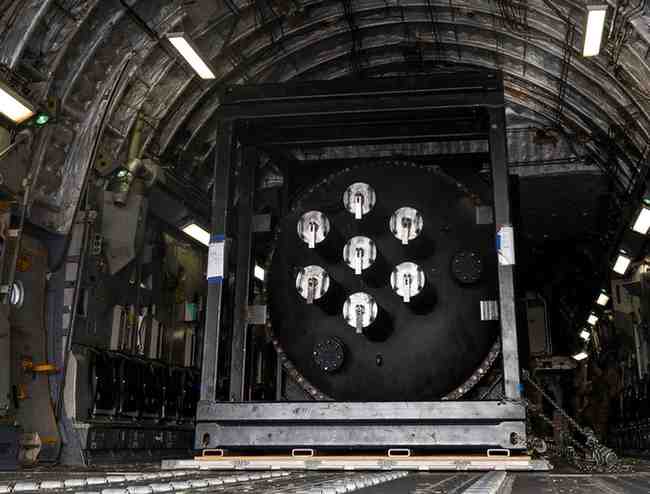
Pentagon and Energy Department Test Rapid Microreactor Deployment
The United States has achieved a landmark in advanced nuclear logistics by conducting its first-ever aerial transport of a micro nuclear reactor aboard a military cargo aircraft. The Departments of Energy and Defense jointly airlifted the Ward microreactor, developed by Valar Atomics, from California to Hill Air Force Base in Utah using a C-17 Globemaster III. The reactor was transported without nuclear fuel, ensuring compliance with safety and regulatory protocols.
Rapid Deployment of Advanced Nuclear Systems
The demonstration underscores Washington’s growing emphasis on compact nuclear technologies capable of rapid relocation. Microreactors are viewed as strategic assets for powering remote military installations, forward-operating bases, and critical infrastructure with minimal logistical dependence on conventional fuel supply chains.
The exercise validates the feasibility of transporting nuclear energy systems via air, significantly enhancing operational flexibility.
Ward Microreactor: Design and Output
The Ward microreactor, slightly larger than a minivan, is engineered to deliver up to five megawatts of electricity at full capacity. Initial operations are scheduled to commence at lower output levels, gradually scaling as performance parameters are verified. Such reactors are designed for modular deployment, resilience, and continuous power generation.
Valar Atomics has indicated plans for phased commercialisation following successful operational validation.
Strategic and Economic Considerations
Small nuclear reactors are increasingly positioned as solutions for rising energy demands, including defence systems and high-performance computing infrastructure. Proponents highlight reliability and reduced carbon emissions compared to diesel-based alternatives. However, concerns persist regarding cost competitiveness relative to large nuclear facilities and renewable energy technologies.
Exam-Focused Points
-
Microreactors → Typically generate up to 10 MW of electricity
-
Criticality → Self-sustaining nuclear chain reaction
-
C-17 Globemaster III → Strategic heavy-lift transport aircraft
-
Hill Air Force Base → Key US Air Force installation in Utah
-
Nevada National Security Site → Major US nuclear research centre
Regulatory and Environmental Challenges
Despite technological advancements, nuclear waste management remains a central policy challenge. Even microreactors produce radioactive waste requiring secure, long-term disposal or reprocessing. The long-term viability of microreactor programmes will depend on regulatory approvals, economic efficiency, and public acceptance.
Month: Current Affairs - Feb 16, 2026
Category: International Security | Science