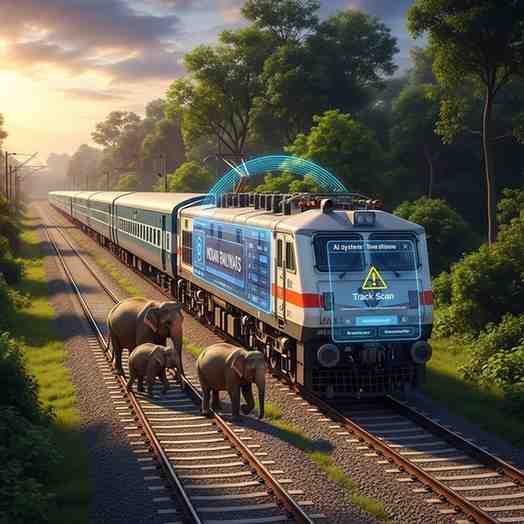
Technology Meets Wildlife Conservation on Indian Railways
Indian Railways has taken a major step towards addressing human–wildlife conflict by introducing an artificial intelligence–enabled Intrusion Detection System (IDS) to prevent train accidents involving elephants. The initiative targets forested and wildlife-sensitive regions where railway tracks intersect traditional elephant corridors , a long-standing challenge in railway safety and conservation.
How the AI-Based Intrusion Detection System Works
The system has been developed by Indian Railways in coordination with the Ministry of Environment Forest and Climate Change .
It uses Distributed Acoustic Sensors (DAS) installed along optical fibre cables laid parallel to railway tracks. These sensors are pre-programmed with the acoustic signatures of elephant movement , enabling the system to identify vibrations caused by elephant locomotion with high accuracy and distinguish them from other environmental noise.
Real-Time Alerts and Operational Reach
When elephant movement is detected near the tracks, the system instantly generates real-time alerts for:
-
Loco pilots
-
Station masters
-
Railway control rooms
This early warning allows trains to slow down or stop , significantly reducing collision risks.
The system is currently operational across 141 route kilometres under the Northeast Frontier Railway , one of the most elephant-sensitive railway zones. Expansion has been sanctioned across several other zones, including East Coast, Southern, Northern, South Eastern, North Eastern, Western, and East Central Railways, covering hundreds of additional route kilometres .
Coordination With Forest Departments
Union Minister Ashwini Vaishnaw informed the Lok Sabha that elephant-train collisions are investigated jointly by railway officials and forest authorities.
Key mitigation steps include:
-
Imposing speed restrictions in sensitive stretches
-
Issuing caution alerts to train crews
-
Regular coordination meetings with wildlife officials
Over the past five years, an average of around 16 elephant-related train accidents per year has been reported, underscoring the urgency of technological and administrative interventions.
Additional Measures for Elephant Protection
Alongside AI-based detection, Indian Railways has implemented multiple wildlife safety measures:
-
Construction of underpasses and ramps for elephant crossings
-
Installation of fencing and warning signage
-
Clearing vegetation near tracks to improve visibility
-
Use of solar-powered LED lighting in forest sections
Other innovations include honey-bee buzzer devices that deter elephants, GPS-based elephant tracking by forest departments, and pilot projects using thermal vision cameras for night-time
Month: Current Affairs - February 05, 2026
Category: Environment & Ecology | Wildlife Conservation