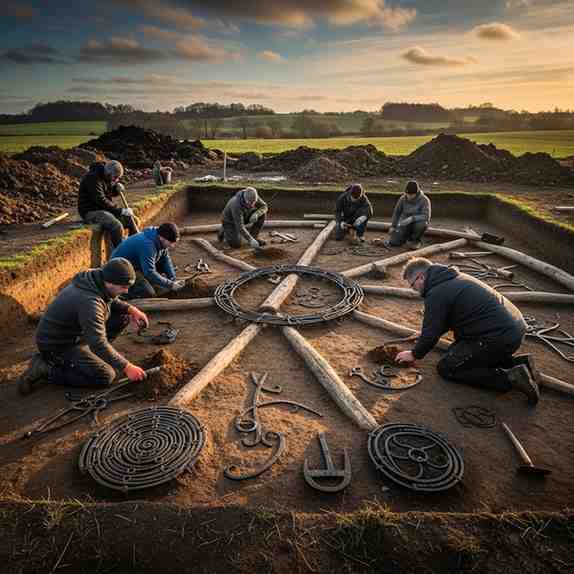
2,000-Year-Old Fortified Settlement Found in Central Jutland
A 2,000-year-old Iron Age temple complex unearthed beneath grasslands at Hedegaard near Ejstrupholm in central Jutland is transforming interpretations of early northern European societies. Danish archaeologists have confirmed that what was once considered routine farmland conceals a fortified settlement of notable political, religious, and economic significance. The scale and architectural sophistication indicate that Hedegaard functioned as a regional power centre around the start of the Common Era rather than a modest rural habitation.
From Burial Ground to Power Centre
The site first drew attention in 1986 when archaeologist Orla Madsen discovered an exceptionally rich burial ground containing weapons and elite grave goods. Although excavations paused in the early 1990s, renewed research led by Museum Midtjylland eventually revealed the burial zone as part of a much larger fortified settlement. Subsequent surveys identified defensive palisades, craft workshops, elite residences, and a central temple, reflecting a socially stratified and organised community.
Ritual Architecture at Hedegaard
At the settlement’s core lies a near-rectangular temple dated to around 0 AD, measuring roughly 15 × 16 metres. A ring of robust posts formed a colonnade surrounding an inner structure built with deeply embedded supports and clay-lined plank walls. The southern-facing entrance opened toward a raised ceremonial hearth, whose decorative stamped patterns suggest ritual usage. The structure provides rare material evidence of formalised religious architecture in Denmark’s Iron Age.
Strategic Defences and Roman Context
The fortified design underscores deliberate defensive planning. Around this period, Roman influence extended to the River Elbe, geographically close to Jutland. Hedegaard’s palisades may reflect regional responses to external pressures. The combination of ritual space, elite dwellings, and workshops signals integrated political authority and economic coordination.
Exam-Focused Points
-
Iron Age (Northern Europe) → Approx. 500 BC – 800 AD
-
Hedegaard → Located in central Jutland, Denmark
-
Roman Expansion → Reached River Elbe around 0 AD
-
Weapon-rich Burials → Often indicate elite warrior status
-
Palisades → Suggest organised defensive strategy
Month: Current Affairs - February 16, 2026
Category: History | Archaeology