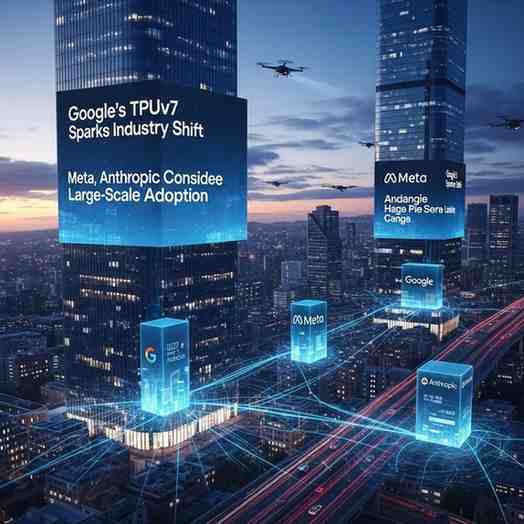
Google’s TPU Platform Re-Enters Center Stage Amid Silicon Valley’s AI Hardware Race
Google has re-emerged as a core driver in the global AI infrastructure landscape—not through search or consumer platforms, but through rapid developments in its Tensor Processing Unit (TPU) hardware. With the unveiling of TPUv7 “Ironwood” , the company has reignited competitive dynamics in the AI accelerator market, drawing serious attention from firms like Meta and Anthropic , both evaluating large-scale TPU deployments.
How Google Built Its TPU Leadership
Google began designing TPUs in 2013 to support AI workloads that conventional CPUs and GPUs could not manage efficiently. These application-specific chips evolved from experimental internal hardware into a mature architecture optimised for matrix-heavy machine learning tasks. While early TPUs were reserved for Google’s cloud and internal models, recent generations have opened pathways for broader industry integration.
Pivot Toward Merchant Silicon
The surge in generative AI has pushed Google to position TPUs as commercially competitive hardware for inference and large-model scaling. Meta’s potential multi-billion-dollar adoption from 2026—marking a shift away from its GPU-only strategy—signals a watershed moment. Anthropic, too, continues expanding its dependence on TPU clusters, suggesting an industry diversification away from Nvidia-centric supply lines.
Competitive Pressures on Nvidia
News of Meta’s TPU interest briefly impacted Nvidia’s stock, reflecting investor concerns about hyperscalers reducing reliance on its GPUs. Although Nvidia maintains an edge through its CUDA software ecosystem and tightly integrated systems, analysts argue that Google’s Ironwood offers comparable performance in compute density and memory throughput.
Exam Oriented Facts
-
First Google TPU introduced: 2015
-
Latest generation: TPUv7 Ironwood
-
Meta considering TPU procurement from 2026 , with deployment by 2027
-
Nvidia’s key advantage: CUDA and broad software ecosystem
-
TPUs are ASICs optimised for tensor operations
Month: Current Affairs - December 07, 2025
Category: AI Hardware, Google TPUs