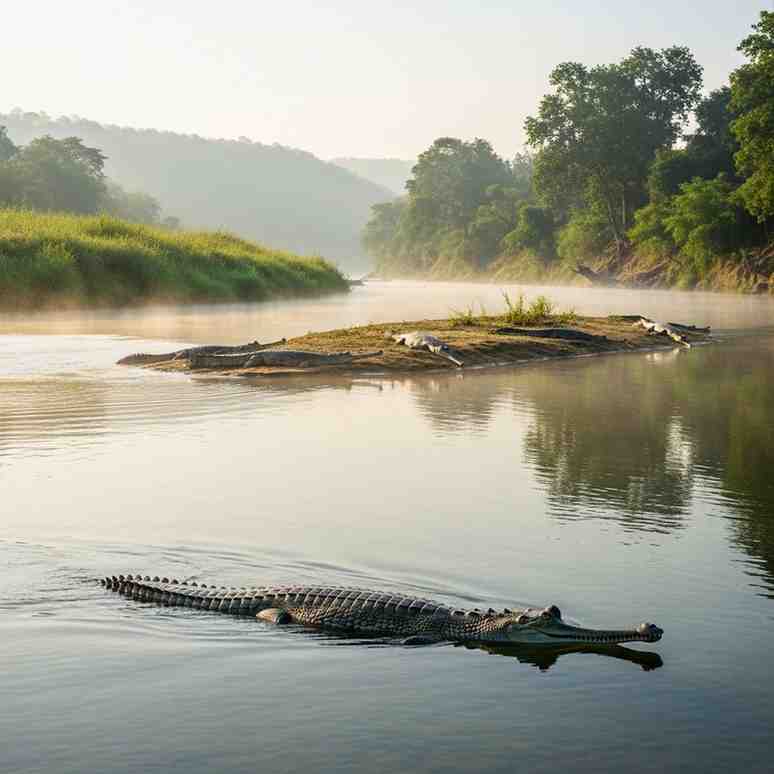
Gandak River Emerges as a Key Stronghold for Gharial Conservation
The Gandak river , flowing along the India–Nepal border through West Champaran district of Bihar , has emerged as the second most significant riverine habitat for gharials in the Indian subcontinent, after the Chambal. A decade of sustained conservation efforts has led to a remarkable revival of this critically endangered fish-eating crocodile , turning the Gandak into a landmark success in riverine wildlife restoration.
Significant Growth in Gharial Population
Forest department records show an extraordinary rise in gharial numbers in the Gandak basin. The population of adult gharials increased from only 54 in 2015 to more than 400 by 2025 . When juveniles and hatchlings are included, the total population now exceeds 1,000 individuals . This places the Gandak just behind the Chambal river, which supports over 2,400 gharials , making it the second-largest habitat of the species in South Asia.
Ideal Habitat and Sustained Protection
According to Neshamani K , Conservator of Forests and Field Director of Valmiki Tiger Reserve , the Gandak provides favourable ecological conditions such as clean water stretches, sandy riverbanks, and protected surroundings. The river’s passage through the reserve has ensured better protection from human disturbance. Focused habitat management, nest monitoring, and strict protection measures have resulted in an annual population growth rate of 20–22% , translating to an overall nearly 588% increase in adult gharials over ten years.
Reintroduction Efforts and Historical Importance
Between 2015 and 2025 , nearly 944 gharials were released into the Gandak across a 326-kilometre stretch from Valmikinagar to Sonepur, including 212 reintroductions in 2025 alone . Conservation expert Samir Kumar Sinha highlighted that the Gandak has played a foundational role in gharial conservation. Eggs collected from this river were used in 1975 to start India’s first captive breeding and release programme at Tikarpada in Odisha, marking the beginning of systematic gharial recovery in the country.
Imporatnt Facts for Exams
-
Gharial ( Gavialis gangeticus ) is listed as Critically Endangered on the IUCN Red List
-
Gandak river is the second-largest gharial habitat in the subcontinent
-
Valmiki Tiger Reserve is located in West Champaran district, Bihar
-
India’s first gharial captive breeding programme began in 1975
-
Community participation is vital for riverine wildlife conservation
Community Involvement and Global Recognition
The International Union for Conservation of Nature (IUCN) recognises the Gandak as one of the six major gharial habitats worldwide . A key factor behind its success has been community-based conservation , involving local residents, trained volunteers, and biologists. These teams actively protect nests, relocate eggs threatened by flooding, and monitor hatchlings to ensure higher survival rates.
Conservationists note that the Gandak model demonstrates how long-term planning, local participation, and scientific management can revive even the most threatened species. Its success offers a scalable blueprint for river-based conservation across South Asia, where freshwater ecosystems face increasing pressure.
Month: Current Affairs - Jan 26, 2026
Category: Environment & Ecology | Wildlife Conservation