India May Ease Curbs on Chinese Firms in Government Tenders
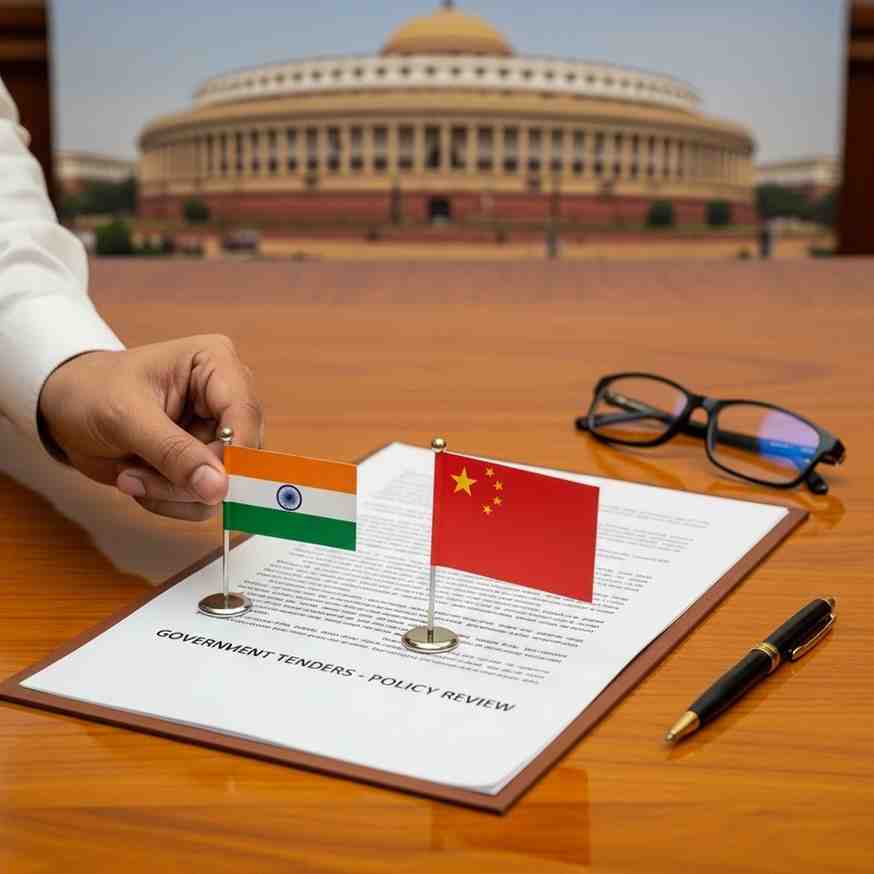
India is preparing to roll back restrictions imposed five years ago on Chinese companies bidding for government contracts, indicating a measured reset in economic engagement with China amid a relative easing of border tensions. The move, being steered by the finance ministry, could reopen access to public procurement opportunities estimated at $700–750 billion , though final approval is still awaited.
Origins of the 2020 Restrictions
The restrictions were introduced in 2020 after a deadly confrontation along the India–China border. Under the policy, firms from China were required to register with a special government committee and secure political and security clearances before being allowed to participate in public tenders. In practice, these conditions largely excluded Chinese companies from government-funded projects, sharply reducing their presence in sectors such as infrastructure, transport, and power.
Proposed Policy Shift
Government officials are now considering removing the compulsory registration and clearance framework. The proposal, initiated by the finance ministry, will require approval from the office of Narendra Modi . Several ministries have reportedly supported the change, arguing that the absence of Chinese suppliers has led to higher costs, supply shortages, and delays in project execution.
Economic and Sectoral Implications
The impact of the curbs has been significant. Chinese state-owned firm CRRC was earlier barred from a $216 million train manufacturing contract, while restrictions on Chinese power equipment affected India’s energy expansion plans. These constraints have slowed progress towards India’s goal of increasing thermal power capacity to around 307 GW over the next decade.
A 2024 study by the Observer Research Foundation found that the value of new projects awarded to Chinese bidders dropped by 27% , falling to $1.67 billion in 2021 following the introduction of the curbs.
Important Facts for Exams
-
India imposed restrictions on Chinese firms in 2020 after border clashes.
-
The curbs affected government procurement worth up to $750 billion .
-
A high-level review committee was led by former Cabinet Secretary Rajiv Gauba .
-
Foreign Direct Investment (FDI) restrictions on Chinese companies remain unchanged.
Broader Geopolitical Context
The possible easing of procurement restrictions comes against the backdrop of a gradual thaw in India–China relations. Following Modi’s visit to China last year—the first in seven years—both countries agreed to cautiously restore commercial engagement. Since then, direct flights have resumed and visa processes for Chinese professionals have been streamlined.
Even so, New Delhi continues to tread carefully. While economic considerations and supply-chain realities are driving a reassessment, strategic sensitivities remain central to policy decisions, particularly as shifting global trade patterns and evolving U.S. tariff policies reshape regional economic alignments.
Month: Current Affairs - January 09, 2026
Category: India-China Bilateral Relations