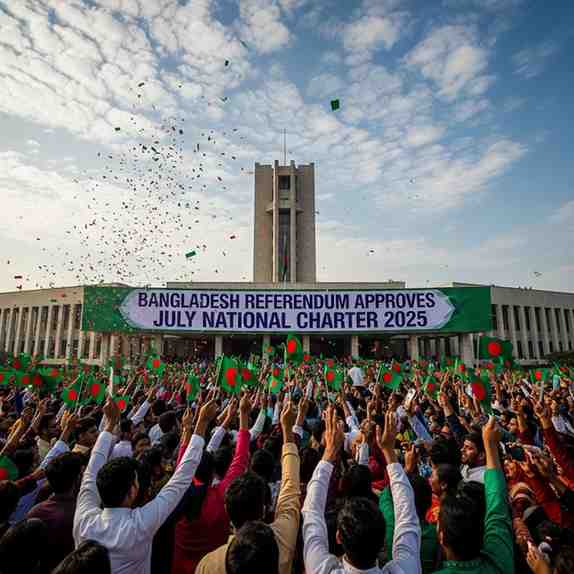
July Charter Reforms Reshape Bangladesh’s Governance Framework
Around 70 per cent of Bangladeshi voters have endorsed the July National Charter 2025 in a national referendum conducted alongside general elections. The Election Commission reported a voter turnout of 60.26 per cent , with 4.8 crore votes in favour of the reforms and 2.25 crore against .
The referendum coincided with a decisive electoral victory for the alliance led by the Bangladesh Nationalist Party , enabling Tarique Rahman to move towards forming the next government. The charter proposes far-reaching constitutional and institutional changes aimed at restructuring Bangladesh’s governance architecture.
Background and Origins of the Charter
The July Charter emerged from the political turbulence triggered by the July 2024 student-led uprising , which culminated in the removal of former Prime Minister Sheikh Hasina . It represents the third major reform blueprint in Bangladesh’s political trajectory.
The document lists 84 reform proposals , of which 47 require constitutional amendments , while 37 can be implemented through legislation or executive action . A Constitutional Reform Council has been tasked with executing the changes within 270 working days .
Major Governance Reforms Proposed
A key objective of the charter is to prevent excessive concentration of executive authority. It introduces strict term limits for prime ministers , targeting prolonged incumbency.
The reforms also propose a transition to a bicameral legislature , including the creation of a 100-seat upper house . Representation in the upper chamber will be based on proportional national vote share , promoting broader political inclusion.
Additionally, the charter seeks to expand presidential powers , thereby recalibrating the executive balance.
Institutional and Democratic Safeguards
The charter emphasises judicial independence and institutional autonomy. It assigns enhanced responsibilities to opposition leaders, including leadership of key parliamentary committees and the deputy speaker role.
Provisions for greater women’s representation and legal protections for participants in the 2024 uprising (“July Fighters”) have also been incorporated.
Exam-Focused Points
-
Bangladesh currently operates a unicameral parliamentary system
-
Constitutional amendments require parliamentary approval
-
Bicameral legislature = Lower + Upper House
-
Referendum = Instrument of direct democracy
-
Charter includes term limits & proportional representation
Month: Current Affairs - February 15, 2026
Category: International Relations | Polity