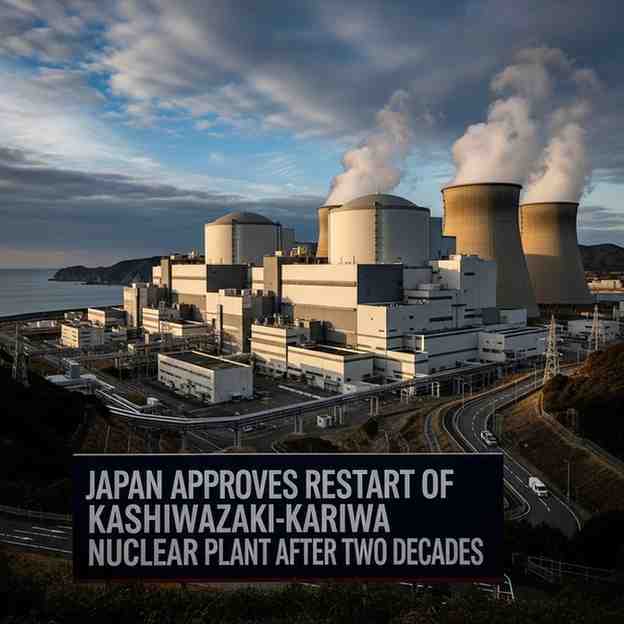
Kashiwazaki-Kariwa Revival Signals Shift in Japan’s Post-Fukushima Energy Policy
Japan has taken a decisive step towards reviving nuclear energy with approval to restart the Kashiwazaki-Kariwa nuclear power plant , the world’s largest by capacity. The decision marks a significant shift in Japan’s post-Fukushima energy policy, driven by concerns over energy security, rising fuel costs, and climate commitments.
Niigata Assembly Gives Crucial Clearance
The restart was approved by the Niigata Prefectural Assembly , endorsing Governor Hideyo Hanazumi’s support for reopening the facility. With this clearance, operator Tokyo Electric Power Company (TEPCO) is authorised to resume power generation. The decision came amid protests by local residents and anti-nuclear groups, reflecting continued public unease over nuclear safety.
Background and Restart Timeline
Situated about 220 km northwest of Tokyo , the Kashiwazaki-Kariwa plant has remained idle since the 2011 Fukushima Daiichi disaster , after which Japan shut down most of its 54 nuclear reactors. The complex houses seven reactors , and Reactor No. 6 is expected to restart operations by January 20, 2026 . TEPCO has pledged to invest nearly ¥100 billion over the next decade to upgrade safety systems, strengthen infrastructure, and meet stringent regulatory standards.
Energy Security and Economic Drivers
Japan’s renewed nuclear push is linked to its heavy dependence on imported fossil fuels. The country spends around ¥10.7 trillion annually on LNG and coal imports, nearly 10% of total import costs . Nuclear power offers a stable, low-carbon domestic energy source that can reduce vulnerability to global fuel price volatility and support long-term energy security.
What to Note for UPSC Prelims?
-
Kashiwazaki-Kariwa is the world’s largest nuclear power plant
-
Most Japanese reactors were shut after the 2011 Fukushima accident
-
TEPCO operates both Fukushima Daiichi and Kashiwazaki-Kariwa
-
Nuclear power is considered a low-carbon energy source
Strategic Policy Shift
Prime Minister Sanae Takaichi’s government has backed nuclear revival as part of Japan’s energy transition. With fossil fuels still generating 60–70% of electricity, Japan aims to raise nuclear power’s share to around 20% by 2040 . The Kashiwazaki-Kariwa restart is central to balancing energy security with decarbonisation goals.
Month: Current Affairs - December 23, 2025
Category: International Affairs, Energy Security