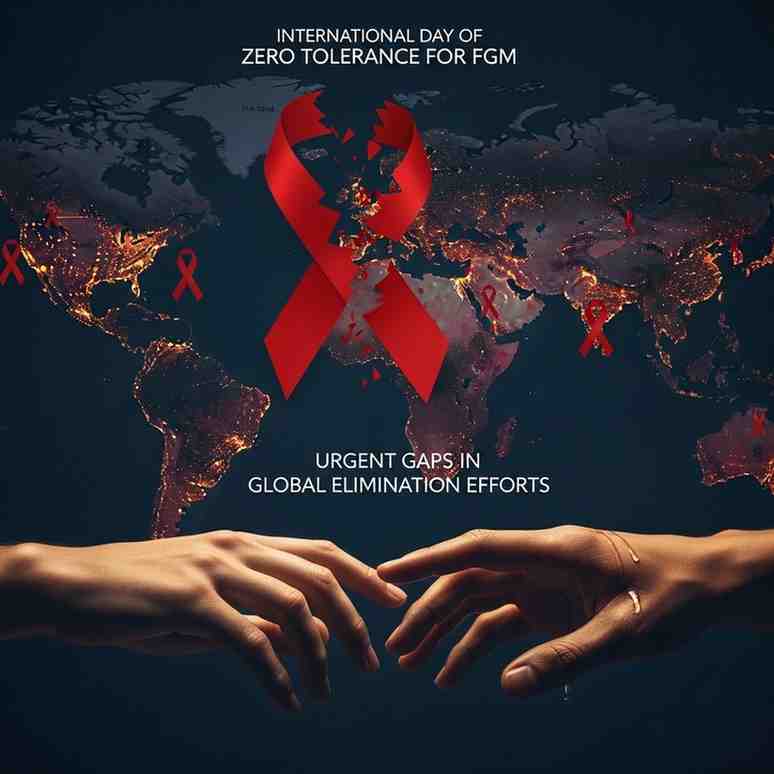
Renewed Global Focus on Ending Female Genital Mutilation
The International Day of Zero Tolerance for Female Genital Mutilation , observed every year on February 6, has once again drawn international attention to one of the gravest violations of the rights of girls and women. Despite decades of advocacy and gradual progress, global agencies caution that the current pace of action is inadequate to achieve complete elimination by the 2030 deadline set under the Sustainable Development Goals.
Scale and Persistence of the Practice
Female genital mutilation (FGM) remains widespread across parts of Africa, the Middle East, and Asia, as well as within migrant communities worldwide. More than 230 million girls and women alive today are estimated to have undergone the practice. Each year, around 4.5 million girls , many below the age of five, are at risk. Projections suggest that if interventions are not accelerated, nearly 22.7 million additional girls could be affected by 2030.
Health, Economic, and Human Rights Consequences
FGM is internationally recognised as a severe violation of human rights, reflecting deep-rooted gender inequality and discrimination. Survivors often experience lifelong physical complications, including obstetric risks, chronic pain, infections, and reproductive health issues, along with long-term psychological trauma. Globally, healthcare systems spend an estimated USD 1.4 billion annually treating complications linked to FGM, placing a sustained burden on public health infrastructure.
Fragile Gains and Emerging Challenges
While legal reforms and community-level interventions have reduced prevalence in some regions, progress remains vulnerable. International organisations warn that funding cuts , reduced investment in education and child protection, increasing medicalisation of FGM , and social backlash against gender rights threaten to stall or reverse gains. Medicalisation—where the practice is carried out by trained health workers—poses particular concern as it lends false legitimacy to a harmful act.
Important Facts for Exams
-
Female genital mutilation is internationally recognised as a human rights violation
-
An estimated 230 million girls and women globally have undergone FGM
-
Medicalisation refers to FGM being performed by health professionals
-
Ending FGM is linked to SDG 5 (Gender Equality) and SDG 3 (Good Health and Well-being)
WHO Guidelines and the Need for a Multisectoral Response
In 2025, World Health Organization , along with the HRP research programme, released updated evidence-based guidelines to strengthen prevention and survivor care. These guidelines prioritise survivor-centred health services, ethical medical practices, and firm opposition to medicalisation. Experts emphasise that eliminating FGM requires long-term, multisectoral action involving communities, educators, religious and traditional leaders, legal systems, media, and resilient health services. With fewer than four years left to meet the 2030 target, sustained financing, political commitment, and coordinated global action remain critical to protecting millions of girls worldwide.
Month: Current Affairs - February 07, 2026
Category: Social Justice | Women’s Rights