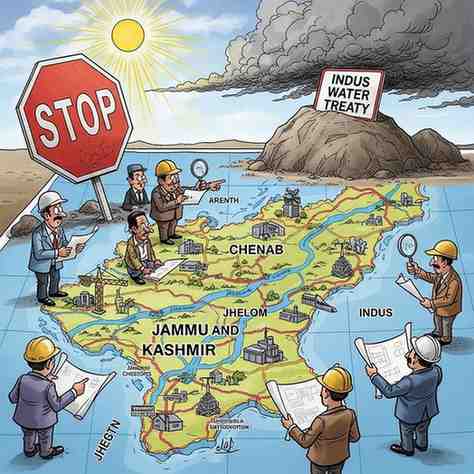
Tulbul Barrage and Ravi Diversion Back in Focus
The Jammu & Kashmir administration is reassessing its water management strategy following the suspension of the Indus Waters Treaty (IWT) . Chief Minister Omar Abdullah has reportedly placed before the Union government proposals to revive the stalled Tulbul Navigation Barrage and to channel surplus flows from the Ravi River toward water-stressed districts in Jammu. The treaty’s placement in abeyance in 2025 has created fresh scope for hydrological planning within the Union Territory.
Tulbul Navigation Barrage Reconsidered
The Tulbul Navigation Project, initiated in 1984 near Wular Lake , was designed to regulate outflows of the Jhelum to sustain navigation depth and stabilise lake levels. Work was halted in 1987 after objections raised under treaty provisions governing western rivers. Authorities now argue that controlled regulation could improve inland water transport, enhance irrigation stability, and support ecological restoration of the lake system.
Beyond navigation, maintaining optimal water levels is expected to benefit wetland biodiversity and agricultural productivity in surrounding areas.
Ravi Water Diversion Plans
Parallel proposals focus on diverting excess Ravi waters to irrigate dry tracts in Kathua and Samba districts. The near completion of the Shahpur Kandi Dam is viewed as a key enabling factor, potentially allowing better flow regulation. Officials emphasise that enhanced utilisation of eastern rivers could mitigate drought risks and expand cultivable land in Jammu.
A large-scale pumping scheme from the Chenab basin has also been discussed to address long-term urban and agricultural demand.
Indus Waters Treaty Context
The IWT (1960), brokered with World Bank facilitation, allocated eastern rivers — Ravi, Beas, Sutlej — to India, and western rivers — Indus, Jhelum, Chenab — largely to Pakistan, with defined usage limits.
Important Facts for Exams
-
IWT signed in 1960 (India–Pakistan, World Bank mediation).
-
Eastern rivers: Ravi, Beas, Sutlej (India).
-
Western rivers: Indus, Jhelum, Chenab (Pakistan).
-
Wular Lake is among India’s largest freshwater lakes .
Strategic and Development Outlook
The renewed initiatives indicate a policy pivot toward maximising river utilisation, strengthening irrigation networks, and revisiting legacy infrastructure. Their execution could reshape regional water governance and economic activity in Jammu & Kashmir.
Month: Current Affairs - February 18, 2026
Category: Polity & Governance | Environment