Scientists Track Chemical Changes in Interstellar Visitor 3I/ATLAS
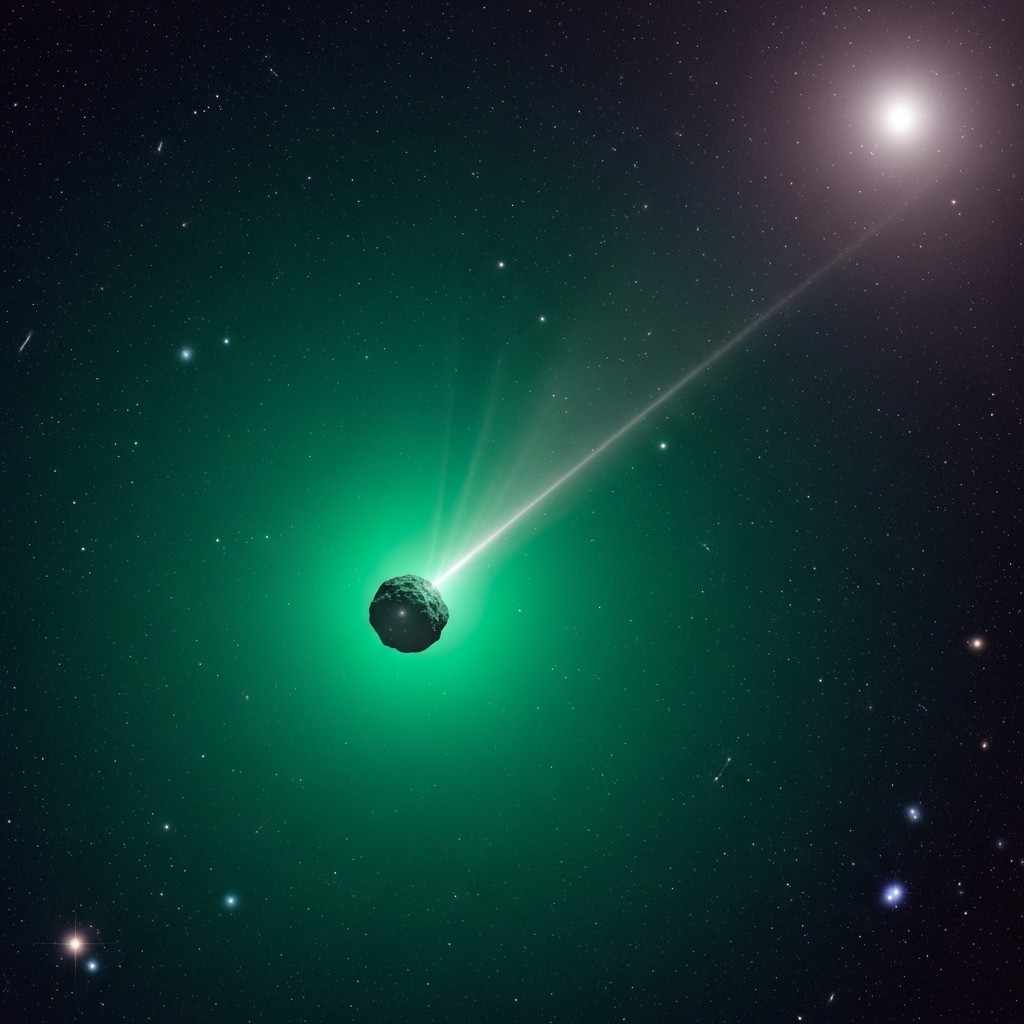
Astronomers worldwide are closely monitoring interstellar comet 3I/ATLAS , which has entered a highly active phase as it moves deeper into the inner solar system. The comet has attracted particular attention due to its rapid increase in brightness and the sudden appearance of a striking green glow, signalling intense chemical activity triggered by solar heating.
Green Emission Reveals Active Chemistry
Following its close solar passage in late October, observers detected a greenish tint in the comet’s surrounding coma. This glow is caused by diatomic carbon (C₂) molecules released when frozen gases sublimate from the comet’s nucleus. Once exposed to sunlight, these molecules fluoresce, producing a green colour. While such emissions are common in solar system comets, they were unexpected in 3I/ATLAS, which initially displayed a reddish appearance.
Solar Heating and Structural Changes
As the comet approaches the Sun, rising temperatures are causing buried ice and dust to vaporise, forming a bright coma and an expanding tail. Observations across multiple wavelengths indicate changes in the comet’s composition compared to earlier stages of its journey. Scientists believe fresh layers of material are being exposed, and further outbursts remain possible as heating continues—behaviour typical of dynamically active comets.
A Rare Interstellar Messenger
3I/ATLAS is only the third confirmed interstellar object ever detected, following 1I/‘Oumuamua and 2I/Borisov . It is travelling on a hyperbolic trajectory at around 210,000 km/h, meaning it will permanently exit the solar system. Researchers suggest it may be among the largest and oldest interstellar bodies observed, preserving material from ancient star-forming regions beyond our galaxy.
Scientific Importance
With its evolving jets, icy composition, and changing chemistry, 3I/ATLAS offers a rare opportunity to study matter formed around other stars. Ongoing observations aim to refine estimates of its size and structure, helping scientists better understand planetary formation processes across the Milky Way.
Exam-Focused Points
-
3I/ATLAS is the third known interstellar object after ‘Oumuamua and Borisov.
-
The green glow is caused by diatomic carbon (C₂) excited by sunlight.
-
It follows a hyperbolic orbit and will not return to the solar system.
-
Closest approach to Earth is about 270 million kilometres .
Month: Current Affairs - December 16, 2025
Category: Space Science