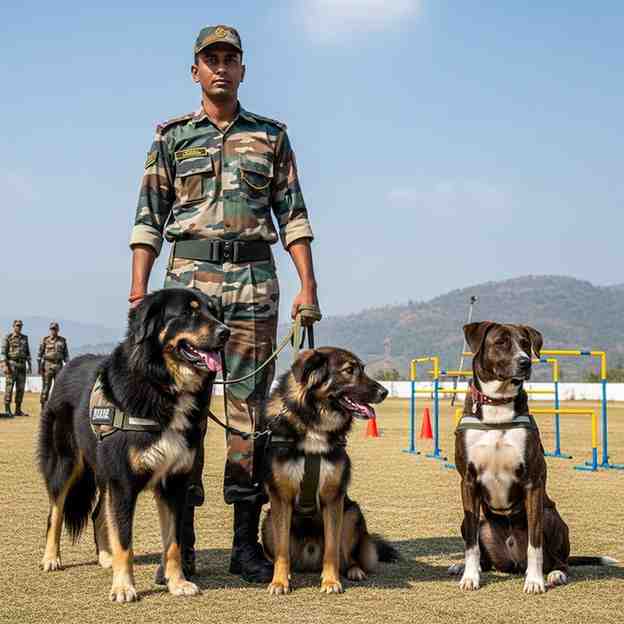
Tangkhul Hui and Kombai Join Canine Squad
The Assam Rifles has initiated the induction of indigenous Indian dog breeds into its canine squad, aligning with the Atmanirbhar Bharat indigenisation strategy. The force has already deployed the Tangkhul Hui breed on a pilot basis and plans to introduce the Kombai breed beginning April.
Emphasis on Native Breeds
The move follows policy guidance encouraging security forces to prioritise Indian breeds. Indigenous dogs are widely regarded as better adapted to local environmental conditions, displaying higher disease resistance and climatic resilience. Six Tangkhul Hui dogs inducted earlier are currently engaged in narcotics detection tasks. The Kombai breed, recognised for agility and guarding instincts, represents the next phase of expansion.
Canine Strength and Training
Assam Rifles maintains an authorised canine strength of 344 dogs, with active deployment across the Northeast and Jammu & Kashmir. The Assam Rifles Dog Training Centre (ARDTC) in Jorhat functions as the primary hub for training and handler development. Programmes include obedience, tracking, explosive detection, and narcotics detection. Advanced specialisation courses enhance operational proficiency.
Operational Significance
Canine units remain critical force multipliers in counter-insurgency, anti-narcotics, and detection missions. Their sensory capabilities significantly improve surveillance and interdiction efficiency. Authorities have also outlined plans for expanding canine roles into dual-purpose operational tasks.
Strategic and Policy Relevance
The induction supports broader defence and security indigenisation efforts by reducing reliance on foreign-origin breeds commonly used in military operations.
Exam-Focused Points
-
Assam Rifles = India’s oldest paramilitary force
-
Policy framework: Atmanirbhar Bharat
-
Tangkhul Hui: Indigenous breed from Manipur
-
Kombai: Native breed from Tamil Nadu
-
Canine roles: tracking, detection, surveillance
Month: Current Affairs - February 13, 2026
Category: Defence & Security | Internal Security