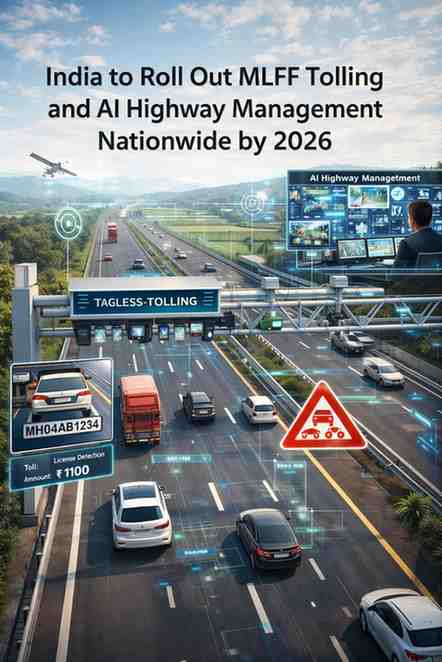
Multi-Lane Free Flow Toll System to Enable Zero Waiting at National Highways
The Union Government has announced plans to complete the nationwide rollout of the Multi-Lane Free Flow (MLFF) tolling system , integrated with artificial intelligence-based highway management , by the end of 2026 . The initiative marks a major shift in India’s road infrastructure strategy, aiming to eliminate congestion at toll plazas and significantly improve travel efficiency on national highways.
Zero Waiting Time at Toll Plazas
Union Minister for Road Transport and Highways Nitin Gadkari , while responding in the Rajya Sabha, stated that the MLFF system will allow vehicles to cross toll points without stopping . The goal is to bring waiting time at toll plazas down to zero minutes . Under this system, vehicles will be able to pass through toll locations at speeds of up to 80 kmph , ensuring uninterrupted traffic flow and a smoother driving experience for commuters.
Technology Framework Behind MLFF
The MLFF tolling mechanism will function through a robust, integrated digital framework. It will combine AI-based number plate recognition (ANPR) , satellite tracking , and FASTag integration . This technology will automatically identify vehicles, calculate toll charges, and deduct fees without any physical barriers or manual checks. The system is designed to reduce human intervention, minimise errors, and enhance operational reliability.
Traffic Efficiency and Revenue Gains
According to the Minister, MLFF is expected to substantially reduce travel time and fuel consumption by removing frequent stoppages at toll plazas. It will also help curb toll revenue leakage and improve transparency in toll collection. Gadkari noted that FASTag had already reduced toll payment time from 3–10 minutes to under one minute , and MLFF would take efficiency to an even higher level.
What to Note for Exams?
-
MLFF stands for Multi-Lane Free Flow tolling system.
-
Nationwide rollout target: by the end of 2026 .
-
Uses AI, satellite tracking and FASTag technologies.
-
Vehicles can cross toll points at speeds of up to 80 kmph .
Digital Highway Management Vision
The government highlighted that digital tolling has already resulted in a significant rise in toll revenues. With the introduction of MLFF and AI-driven highway management, India is expected to achieve greater efficiency, transparency and sustainability in road transport, reinforcing the shift towards smart and technology-enabled national highways .
Month: Current Affairs - December 20, 2025
Category: Infrastructure, Transport Technolog