Radiocarbon Dating Pushes Harappan Chronology Back by Millennia
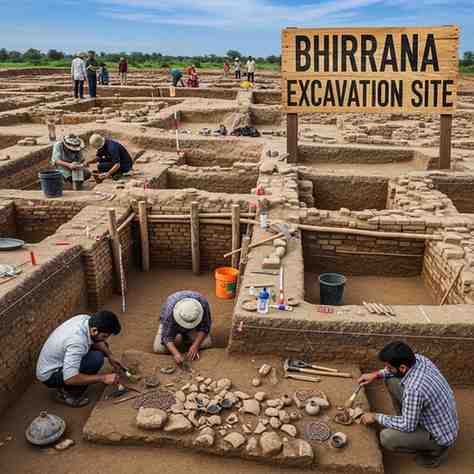
Fresh archaeological evidence indicates that the Indus Valley Civilisation (IVC) may be significantly older than conventionally believed. Radiocarbon dating from deep cultural layers at Bhirrana, a key site in Haryana, suggests human settlement dating back nearly 8,000 years. If validated, these findings could substantially revise the timeline of early complex societies.
New Chronological Insights from Bhirrana
Researchers analysed pottery fragments and faunal remains recovered from stratified layers at Bhirrana. Radiocarbon results indicate occupation extending close to 9,000 years before present. This suggests the presence of early agrarian communities long before the Mature Harappan urban phase (traditionally dated 2600–1900 BCE).
The findings reinforce the interpretation of the Indus civilisation as a product of gradual socio-cultural evolution rather than sudden urbanisation.
Evidence of Advanced Urban Systems
Major Harappan centres such as Harappa, Mohenjo-daro, and Dholavira exhibit highly developed urban planning. Grid-patterned streets, standardised brick architecture, private wells, and covered drainage systems reflect sophisticated civic engineering.
Archaeological remains including granaries, dockyards, seals, and uniform weights indicate organised economic administration. Notably, the absence of monumental temples or royal palaces distinguishes the IVC from Egypt and Mesopotamia, implying alternative governance structures.
Geographical Scale and Cultural Cohesion
At its zenith, the civilisation extended across vast regions of present-day Pakistan and north-western India. Artefacts such as beads, bronze tools, and inscribed seals demonstrate technological proficiency and long-distance trade linkages.
Debates on Environmental Adaptation
Earlier hypotheses attributed decline to climatic shifts, including weakening monsoons and river course changes. Evidence from early sites like Bhirrana suggests adaptive transitions, including shifts toward drought-resistant crops such as millets.
Exam-Focused Points
-
Indus Valley Civilisation → Bronze Age urban civilisation
-
Mature Phase → 2600–1900 BCE (traditional chronology)
-
Key Sites → Harappa, Mohenjo-daro, Dholavira, Rakhigarhi, Bhirrana
-
Indus Script → Undeciphered
-
Standardised Weights → Indicator of regulated trade
Month: Current Affairs - February 15, 2026
Category: Ancient History | Archaeology