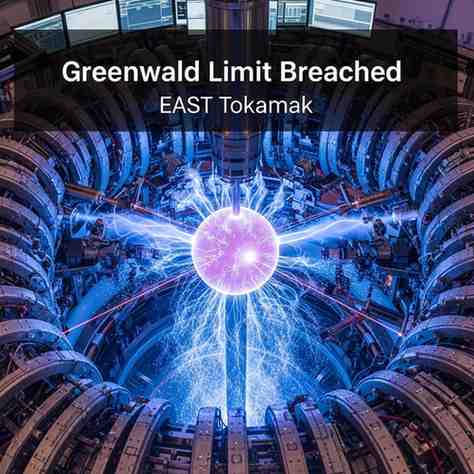
China’s EAST Tokamak Surpasses Long-Standing Plasma Density Barrier in Fusion Breakthrough
Scientists working on China’s Experimental Advanced Superconducting Tokamak (EAST) have achieved a landmark advance in nuclear fusion research by sustaining plasma densities well above a long-accepted theoretical threshold. The achievement represents an important step towards burning plasma , a condition essential for making fusion energy practically viable.
Crossing the Greenwald Density Threshold
Magnetic confinement fusion devices like tokamaks depend on maintaining extremely hot and dense plasma in a stable state. For decades, researchers believed plasma density was capped by the Greenwald limit , beyond which instabilities would cause plasma collapse. Experiments at EAST, located in Hefei, demonstrated stable plasma densities reaching 1.3 to 1.65 times this limit—levels previously considered unachievable.
The findings, published on January 1 in Science Advances , indicate that tokamaks can operate in a new, high-density regime without triggering disruptions.
Technical Innovations Behind the Success
The breakthrough was enabled by a series of coordinated engineering and operational innovations. Researchers employed electron cyclotron resonance heating during plasma initiation, ensuring controlled and uniform temperature rise. Fueling strategies were also modified: experiments began with higher deuterium gas input, followed by hydrogen as plasma temperature increased.
In addition, tungsten reactor walls were coated with lithium. This significantly reduced impurity release from the walls into the plasma, improving confinement quality and allowing higher plasma density without destabilisation.
Validation of Plasma–Wall Self-Organisation Theory
The results provide strong experimental support for the plasma-wall self-organisation theory , proposed in 2021. The theory predicts two stable operational regimes in tokamaks—one constrained by density limits and another where density can rise freely under suitable conditions. EAST’s experiments clearly operated in this second regime, aided by a cooler divertor region where plasma interacts with reactor walls, minimising heat loss and material erosion.
Why This Matters for Global Fusion Efforts
Although the EAST experiments were conducted over short durations and at modest power levels, they challenge the long-held assumption that plasma density is fundamentally restricted. Higher density operation could allow fusion reactors to achieve ignition at lower temperatures or with reduced confinement time.
This has direct relevance for ITER , the world’s largest fusion experiment under construction in France, in which India is a key partner. Overcoming density constraints is considered crucial for making future fusion power plants economically and technically feasible.
Key Exam-Focused Points
-
The Greenwald limit defines the traditional maximum stable plasma density in tokamaks.
-
Tokamaks use magnetic confinement to sustain high-temperature plasma.
-
Electron cyclotron resonance heating employs microwaves to heat plasma electrons.
-
EAST is China’s flagship experimental superconducting tokamak reactor.
-
Higher plasma density can ease conditions for achieving fusion ignition .
Month: Current Affairs - Jan 14, 2026
Category: Science and Technology, Energy