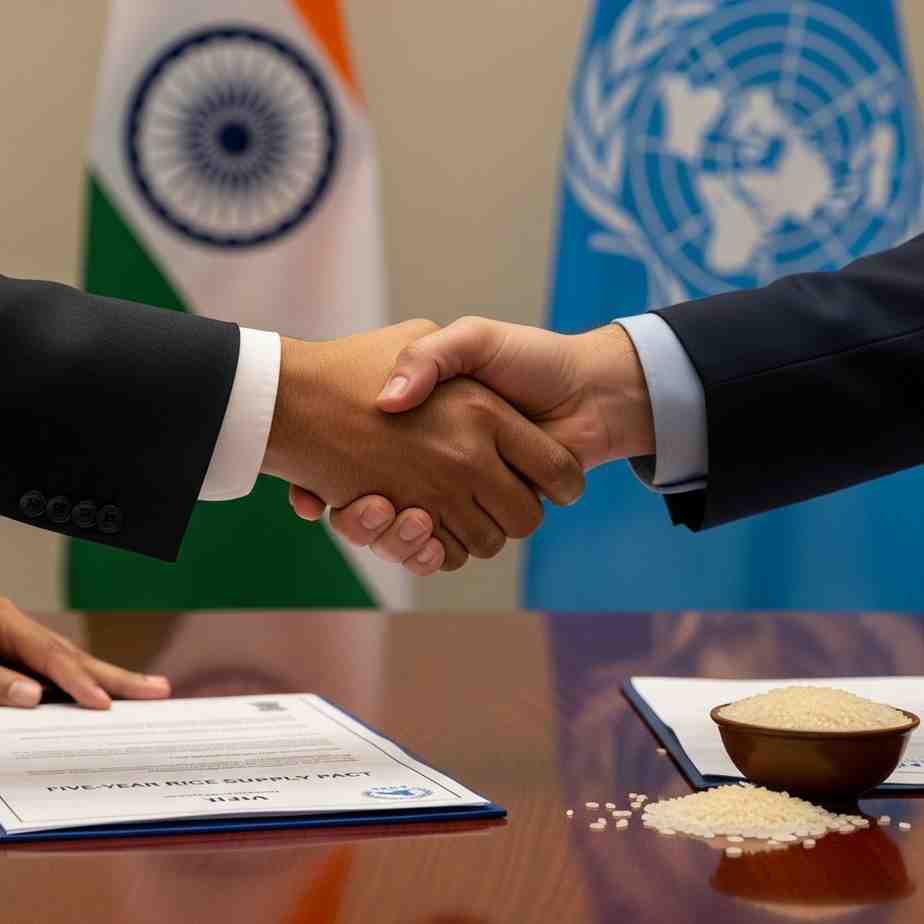
India Expands Global Hunger Relief Role Through WFP Agreement
India has entered into a five-year agreement with the United Nations World Food Programme (WFP) to support international hunger relief efforts through assured rice supplies. The partnership reflects India’s expanding contribution to global food security at a time when humanitarian needs are rising due to conflicts, climate disruptions and economic instability. The agreement reinforces New Delhi’s growing role in multilateral humanitarian cooperation, particularly across Africa, West Asia and other crisis-affected regions.
Framework and Supply Commitments
The Memorandum of Understanding (MoU) was concluded between the Food Corporation of India (FCI) and the World Food Programme. Under the arrangement, India will provide up to 200,000 metric tonnes of rice over the five-year period to facilitate WFP’s emergency food assistance programmes. The rice consignments may include up to 25 per cent broken grains, consistent with established humanitarian distribution standards. The agreement also includes a provision for extension beyond the initial term through mutual consent.
Pricing and Operational Mechanism
Pricing of rice will be determined annually through consultations between FCI and WFP, ensuring flexibility while maintaining predictability. For the present cycle, the price has been fixed at ₹2,800 per quintal until March 31, 2026. This structured approach supports logistical planning, procurement stability and timely deployment of food assistance. The pact establishes procedural clarity regarding sourcing, quality norms and delivery frameworks aligned with WFP operations.
India’s Position in Global Food Security
India’s participation underscores its status as a major agricultural producer and a stabilising force in global grain markets. As the world’s largest exporter of rice, India remains central to international food supply chains. The agreement enhances WFP’s capacity to deliver food aid efficiently to vulnerable populations facing acute shortages.
Important Facts for Exams
-
World Food Programme (WFP) received the Nobel Peace Prize in 2020.
-
Food Corporation of India (FCI) manages public food grain procurement and distribution.
-
India is the world’s largest exporter of rice.
-
Sustainable Development Goal 2 (SDG 2) targets Zero Hunger.
Strategic and Diplomatic Significance
The agreement aligns with India’s broader outreach to the Global South. By leveraging agricultural strength for humanitarian assistance, India strengthens its development diplomacy while balancing domestic food security priorities.
Month: Current Affairs - February 19, 2026
Category: International Relations | Food Security